

+86-17372713393 sale01@alpha-cnc.com

Four-Jaw Chuck Interference Solution for Lathe | Alpha

  • CONVENTIONAL MACHINE
  • LATHE
Posted by NANJING ALPHA CNC CO., LTD On Mar 02 2026

Four-Jaw Chuck Interference Handling for Alpha 46 & 56 Series Lathe

In heavy-duty turning applications, increasing chuck size improves clamping capacity and workpiece flexibility. However, improper dimensional coordination between the chuck and chuck cover bracket can result in mechanical interference under maximum clamping range.

This technical guide explains the interference issue between the four-jaw chuck and chuck cover bracket on Alpha 46 and 56 Series lathes, along with precise engineering modification solutions.


Standard Configuration of 46 & 56 Series Lathe

Alpha standard configurations:

  • 46 Series Lathe → 300mm four-jaw chuck

  • 56 Series Lathe → 350mm four-jaw chuck

Under these standard sizes, the existing chuck cover bracket design ensures full rotational clearance with no interference.


Actual Delivered Chuck Size and Interference Analysis

In some shipments, upgraded chuck sizes were delivered:

  • 46 Series → 320mm four-jaw chuck

  • 56 Series → 400mm four-jaw chuck

After theoretical simulation and rotation envelope analysis:

Model Chuck Size Interference at Max Clamp Range
46 Series 320mm 4mm interference
56 Series 400mm 6mm interference

The interference occurs between the outer jaw projection and the chuck cover bracket support at maximum jaw extension.

This issue does not affect machining accuracy but restricts full rotational clearance.


Solution 1 – Delivery Without Chuck Cover

If the lathe is delivered without chuck cover, the original upgraded chuck configuration can be used directly.

No structural modification required.


Solution 2 – Standard Matching With Chuck Cover Installed

When chuck cover is required:

  • 46 Series → Use 300mm four-jaw chuck

  • 56 Series → Use 350mm four-jaw chuck

This ensures full safety compliance and mechanical clearance without redesign.


Engineering Modification for Shipped 320mm / 400mm Units

For machines already delivered with:

  • 46 Series + 320mm chuck

  • 56 Series + 400mm chuck

Alpha provides a structural adjustment solution:

Step 1: Reposition Bracket Mounting Threads

Adjust the 2-M6 mounting thread position:

  • Move backward: 10mm

  • Move upward: 6mm

This modification shifts the bracket out of the interference zone.
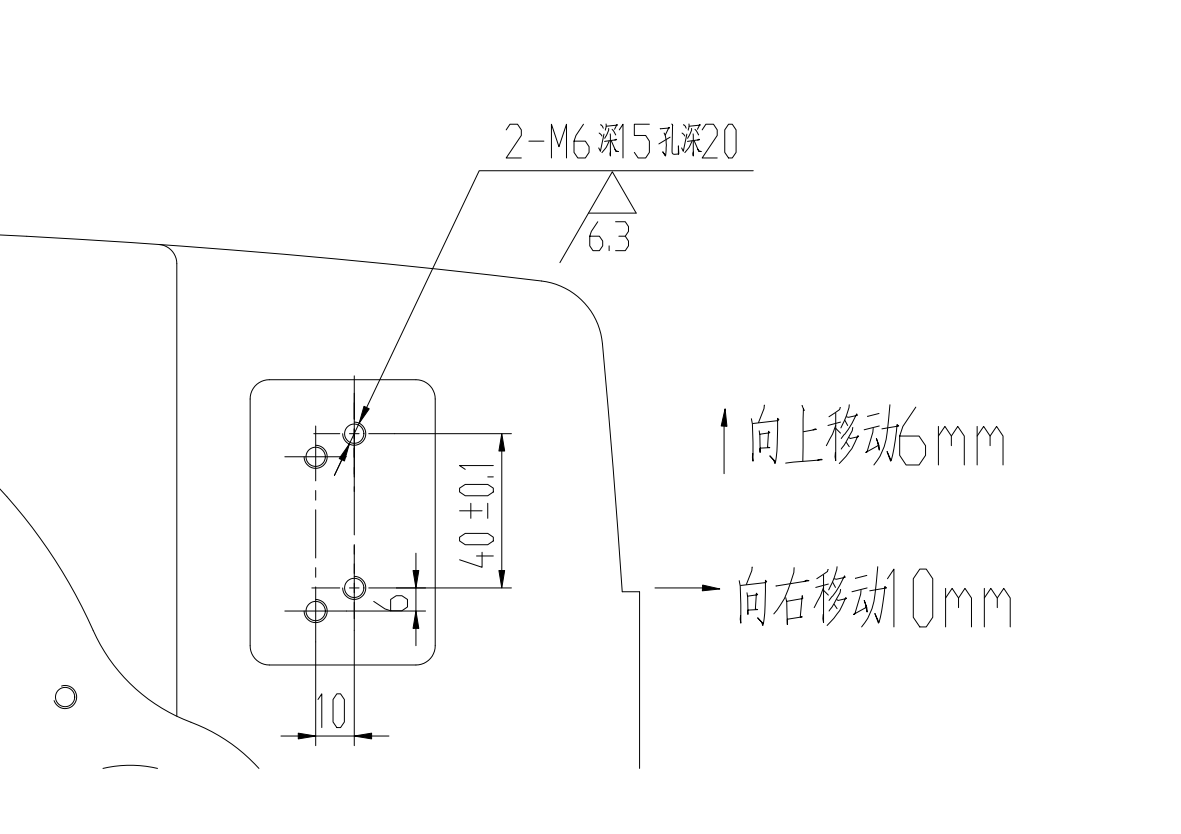

Four jaw chuck bracket repositioning dimensions for Alpha lathe

This image illustrates the 10mm backward and 6mm upward relocation of the 2-M6 mounting threads to eliminate interference.


Step 2: Fine Adjustment of Chuck Cover Angle

After bracket repositioning:

  • Slightly adjust the working angle of the chuck cover

  • Fine-tune the two set screws

This guarantees maximum rotational clearance during operation.
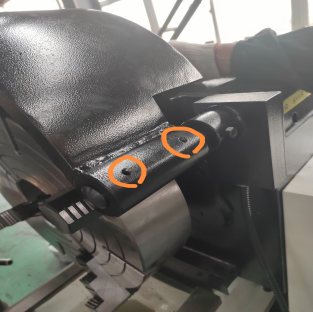

Chuck cover angle fine adjustment using set screws
Demonstrates fine-tuning procedure to ensure maximum rotational clearance.


Verified Result on 660 Lathe Model

After applying the modification:

  • 400mm four-jaw chuck achieves full maximum rotation

  • No interference occurs

  • Safety cover remains fully functional


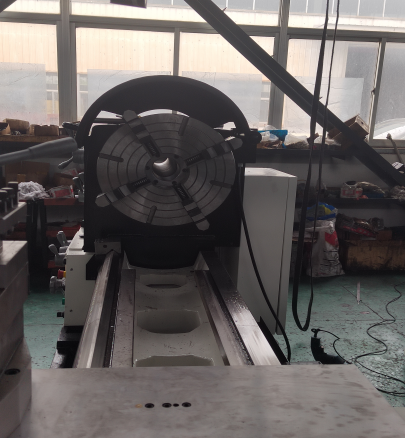
Alpha 660 lathe with 400mm four jaw chuck and modified bracket
Shows completed installation with full rotational clearance.


Custom Orders With 320mm / 400mm Chuck

For customers who specifically require:

  • 46 Series + 320mm

  • 56 Series + 400mm

Alpha manufactures the bracket directly according to the modified mounting position defined in Figure 1.

This ensures factory-level precision without on-site adjustment.


Why Engineering Clearance Design Matters in Lathe Manufacturing

Interference in rotational components can lead to:

  • Restricted clamping range

  • Safety cover misalignment

  • Reduced operational envelope

  • Risk during high-speed rotation

Alpha performs simulation-based dimensional analysis before structural modification, ensuring mechanical compatibility and operational safety.


FAQ

Q1: Why does a larger four-jaw chuck cause interference?

Because maximum jaw extension increases radial projection, which may enter the bracket support zone if not redesigned.

Q2: Does this interference affect machining precision?

No. It only affects rotational clearance when the chuck cover bracket is installed.

Q3: Can the bracket be modified on-site?

Yes. By relocating the 2-M6 mounting threads (10mm backward, 6mm upward).

Q4: Is the modification required for all machines?

Only for units using 320mm (46 Series) or 400mm (56 Series) chucks with a chuck cover installed.

Q5: Can Alpha pre-configure the correct bracket?

Yes. For specified orders, Alpha supplies the modified bracket directly.
Featured Blogs
How a 4-Roller Plate Rolling Machine Improves Plate Rolling Accuracy and Reduces Material Waste in the USA

How a 4-Roller Plate Rolling Machine Improves Plate Rolling Accuracy and Reduces Material Waste in the USA

For American metal fabrication companies, achieving consistent plate curvature while minimizing material waste is a major production challenge. This article explores how a 4-roller plate rolling machine helps manufacturers improve rolling accuracy, control material deformation, reduce operator dependency, and achieve more reliable production results. It also explains important machine selection factors for businesses processing carbon steel, stainless steel, and other industrial metal plates.

How a 4-Roller Plate Rolling Machine Helps Mexican Manufacturers Meet Tight Production Deadlines

How a 4-Roller Plate Rolling Machine Helps Mexican Manufacturers Meet Tight Production Deadlines

As Mexico strengthens its position in North American manufacturing and nearshoring supply chains, metal fabrication companies face growing pressure to deliver customized products within shorter production schedules. This article explores how a 4-roller plate rolling machine helps Mexican manufacturers improve production flexibility, simplify workpiece handling, reduce unnecessary setup operations, and process different cylindrical components more efficiently.

NR-12 Safety Requirements for 4-Roller Plate Rolling Machines: What Brazilian Manufacturers Need to Know

NR-12 Safety Requirements for 4-Roller Plate Rolling Machines: What Brazilian Manufacturers Need to Know

For Brazilian metal fabrication companies, purchasing industrial machinery involves more than evaluating processing capacity and price. Machinery safety and NR-12 requirements are also important considerations when importing and installing equipment. This article explains the key safety aspects buyers should evaluate when selecting a 4-roller plate rolling machine, including roller guarding, emergency stop systems, hydraulic safety, electrical controls, operator training, and Portuguese technical documentation. It also provides practical guidance for preparing imported plate rolling equipment for safe industrial operation in Brazil.

Improving Plate Rolling Consistency in Colombia: How a 4-Roller Plate Rolling Machine Handles Mixed Production Requirements

Improving Plate Rolling Consistency in Colombia: How a 4-Roller Plate Rolling Machine Handles Mixed Production Requirements

For metal fabrication companies in Colombia, producing consistent rolled components from different plate sizes and material specifications can be a daily production challenge. Changes in plate thickness, width, material strength, and required diameter can make forming results difficult to repeat, especially when operators rely heavily on manual adjustments. A 4-roller plate rolling machine offers a practical approach to improving plate positioning, controlling pre-bending, and maintaining a more stable forming process. This article explains how four-roll technology can help Colombian manufacturers reduce dimensional variation, improve production repeatability, and build a more reliable workflow for tanks, cylindrical shells, structural components, and other rolled products.

How to Minimize Machine Downtime with a 4-Roller Plate Rolling Machine in Mexico

How to Minimize Machine Downtime with a 4-Roller Plate Rolling Machine in Mexico

For Mexican metal fabrication companies, unexpected machine breakdowns can interrupt production, increase maintenance expenses, and delay customer deliveries. This article explains how to evaluate a 4-roller plate rolling machine from a long-term reliability perspective. It covers hydraulic system maintenance, roller inspection, spare parts planning, operator training, preventive maintenance, and supplier support to help manufacturers reduce equipment downtime and maintain stable production.

Choosing the Right 4-Roller Plate Rolling Machine in Colombia: Avoiding Overinvestment and Improving Production Capacity Utilization

Choosing the Right 4-Roller Plate Rolling Machine in Colombia: Avoiding Overinvestment and Improving Production Capacity Utilization

For Colombian metal fabrication companies, investing in a 4-roller plate rolling machine is not simply a matter of choosing the largest available capacity. Changes in project demand, steel costs, financing pressure, and competition can make equipment investment decisions more complicated. An oversized machine may increase initial investment and operating costs without delivering enough additional production value, while an undersized machine can restrict future orders and create production bottlenecks. This article explains how Colombian manufacturers can evaluate plate thickness, working length, rolling diameter, pre-bending capacity, control systems, and actual production requirements to select a machine that balances investment, flexibility, and long-term utilization.