

Labor Shortages: A Growing Challenge for American Metal Fabricators
The American metal fabrication industry is facing increasing pressure to improve productivity while managing labor costs. Manufacturers producing storage tanks, pressure vessels, industrial pipes, steel structures, and heavy machinery must maintain production capacity even when experienced machine operators are difficult to recruit and retain.
Finding skilled workers is only part of the problem. Training new employees, maintaining consistent operating procedures, and managing labor-intensive production processes also require considerable time and resources.
Plate rolling is one of the operations where operator experience can significantly influence production efficiency.
Traditional rolling processes may require repeated plate positioning, manual adjustments, and additional handling between pre-bending and rolling stages. These tasks increase the workload on operators and make production efficiency more dependent on individual experience.
For American fabrication shops handling customized orders and different material specifications, reducing unnecessary manual operations is becoming an important equipment investment consideration.
A 4-roller plate rolling machine offers a more integrated approach to plate forming. By combining plate clamping, edge pre-bending, and rolling operations within one machine configuration, it can help simplify the production workflow and reduce operator involvement in repetitive handling tasks.
Why Labor Efficiency Matters in the US Plate Rolling Industry
Labor costs are an important part of the total operating expenses for American manufacturing businesses.
In many metal fabrication workshops, production efficiency depends not only on machine speed but also on how effectively operators manage material handling, setup, positioning, and workpiece inspection.
When a rolling operation requires several manual adjustments, operators spend valuable time managing the process instead of preparing the next workpiece or performing other production tasks.
This can create three major challenges.
Dependence on Experienced Machine Operators
Plate rolling requires an understanding of material behavior, roller positioning, bending sequences, and dimensional requirements.
Different steel grades and thicknesses respond differently to bending forces. Operators must understand how to adjust the process to achieve the required shape.
When a workshop relies heavily on a small number of experienced workers, production may become vulnerable to employee turnover, retirement, or unexpected absences.
A machine with a more integrated operating process can help standardize repetitive operations and reduce unnecessary manual intervention.
Time-Consuming Material Handling
Large steel plates are difficult to handle manually.
During conventional rolling operations, repeated repositioning can increase handling time and require additional coordination between operators and material handling equipment.
For manufacturers processing heavy plates, every unnecessary movement adds time to the production cycle.
A four-roll configuration helps simplify this process by allowing the plate to remain clamped during important stages of the rolling operation.
Inconsistent Production Efficiency
When different operators use different adjustment methods, production time and processing results may vary.
This is particularly challenging for manufacturers producing customized cylindrical components in small and medium batches.
Standardized machine operations and repeatable roller positioning can help reduce these variations and make production planning more predictable.
How a 4-Roller Plate Rolling Machine Reduces Manual Operations
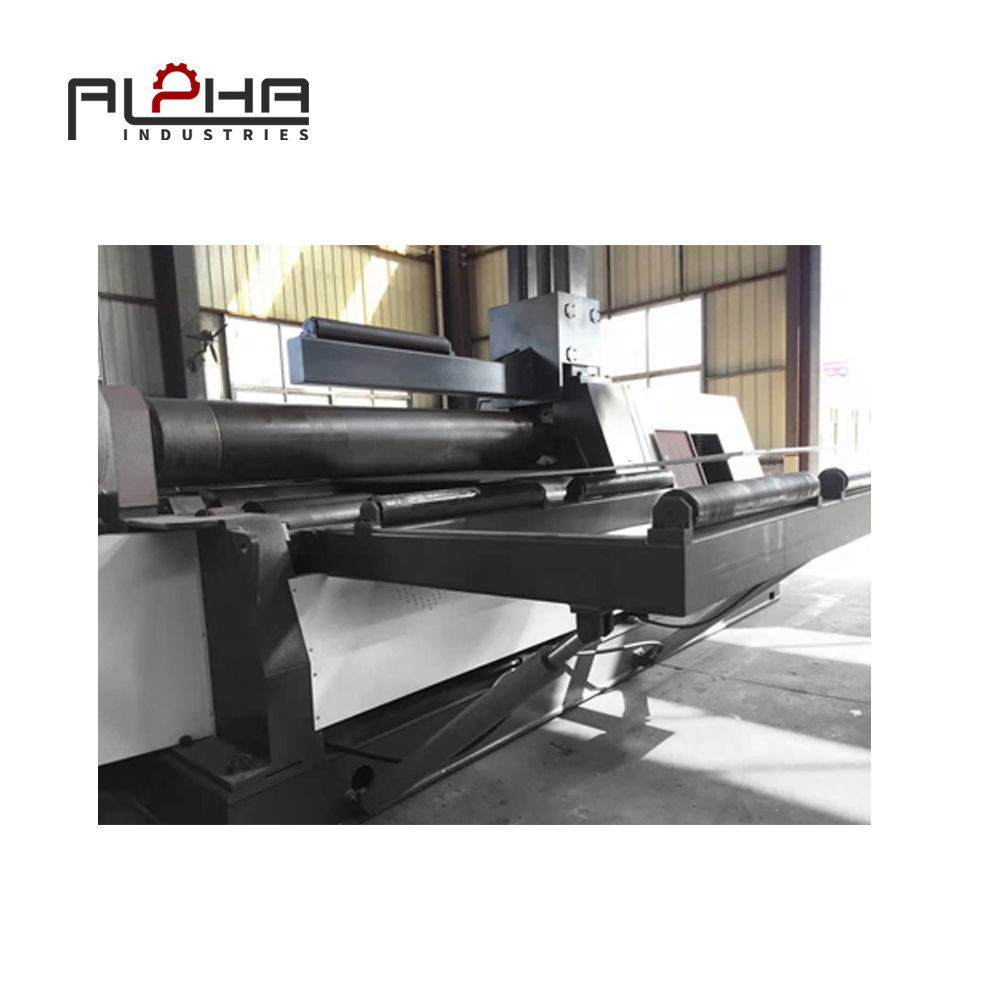
A 4-roller plate rolling machine is designed around an integrated roller arrangement that supports plate positioning, clamping, pre-bending, and rolling.
Its typical structure includes one upper roller, one lower roller, and two side rollers.
Each roller performs a specific function during the forming process. Their coordinated movement allows the machine to handle multiple rolling stages without requiring the same level of repeated manual repositioning associated with some conventional processes.
Integrated Plate Clamping Simplifies Operation
One of the main advantages of a four-roll machine is its ability to clamp the steel plate between the upper and lower rollers.
This provides more controlled plate positioning during the rolling process.
The operator can position the plate, establish the required clamping condition, and perform the next forming operation through controlled roller movements.
This arrangement helps reduce unnecessary plate handling and makes the workflow more straightforward.
For workshops processing large steel sheets, reducing repositioning operations can improve both production efficiency and workplace organization.
Pre-Bending and Rolling in One Integrated Process
Pre-bending is an important stage in manufacturing cylindrical metal components.
The plate edges must be bent before the main rolling operation to reduce flat sections at the ends of the finished workpiece.
A four-roll plate rolling machine can perform edge pre-bending and subsequent rolling without repeatedly removing and repositioning the plate.
This integrated process reduces handling requirements and helps operators manage the production sequence more efficiently.
For storage tank manufacturers and pressure vessel fabricators, it can also simplify the preparation of cylindrical sections before welding.
Reduced Setup and Adjustment Time
Different workpieces may require different rolling diameters, plate thicknesses, and material settings.
In a busy fabrication workshop, frequent changes between product specifications can consume a considerable amount of production time.
When equipped with a suitable CNC control system, a four-roll plate rolling machine can support programmable roller positioning and repeatable operating procedures.
Operators can use established parameters for recurring jobs instead of relying entirely on manual adjustments.
The actual setup time savings depend on the machine configuration, workpiece complexity, material characteristics, and operator training.
Easier Standardization of Production Procedures
Manufacturing companies need consistent procedures to maintain quality across different shifts and production teams.
A CNC-controlled plate rolling machine can help establish standardized operating parameters for recurring workpieces.
This is particularly useful for businesses that manufacture similar cylindrical components in repeated batches.
By reducing dependence on individual adjustment habits, manufacturers can make operator training more structured and improve production management.
However, automation does not eliminate the need for skilled operators. Material selection, workpiece inspection, safe machine operation, and process verification remain important.
Why Four-Roll Technology Is Valuable for Small and Medium-Sized Fabrication Shops
Large manufacturing plants may have dedicated production teams and automated material handling systems. Smaller fabrication businesses often operate with more limited staffing and workshop space.
For these companies, equipment that reduces unnecessary manual work can provide practical operational advantages.
A 4-roller plate rolling machine can support several types of production activities.
Storage Tank Manufacturing
Storage tank manufacturers need to roll steel plates into cylindrical shell sections before welding and assembly.
An integrated pre-bending and rolling process helps simplify workpiece handling and reduce additional adjustment operations.
Pressure Vessel Fabrication
Pressure vessel production requires carefully controlled dimensions and consistent manufacturing procedures.
A suitable four-roll machine can help operators process cylindrical sections while maintaining repeatable forming parameters.
The required machine capacity must be selected according to the material grade, plate thickness, working width, and design diameter.
Industrial Pipe and Cylindrical Component Production
Companies producing large-diameter cylindrical components need equipment capable of handling different plate dimensions.
Four-roll technology can support a more efficient workflow when processing multiple workpiece specifications.
Heavy Equipment Manufacturing
Heavy equipment manufacturers often process thick steel plates for structural and cylindrical components.
Reducing repeated handling can help improve workshop productivity and make better use of available labor resources.
CNC Control: Supporting a More Efficient Rolling Workflow
For American manufacturers looking to improve production management, CNC control is an important factor when evaluating a plate rolling machine.
A CNC system can support more precise roller positioning and help operators reproduce established processing procedures.
Depending on the machine configuration, available functions may include:
-
Programmable roller positioning
-
Digital position display
-
Repeatable rolling sequences
-
Stored processing parameters
-
Controlled movement of side rollers
-
Simplified operation for recurring production tasks
These functions can help reduce the time spent on repetitive adjustments.
However, buyers should evaluate the actual CNC functions instead of assuming that all four-roll machines offer the same automation capabilities.
For businesses with frequent production changes, an appropriate control system can make it easier to manage different workpiece specifications.
For manufacturers producing standardized components in larger batches, repeatable operating procedures can help improve production planning.
How to Select a 4-Roller Plate Rolling Machine for Labor-Efficient Production
Choosing equipment based only on maximum rolling thickness may lead to an unsuitable investment.
Manufacturers should consider the relationship between machine capacity, operating convenience, production volume, and labor requirements.
Evaluate Actual Production Capacity
Start by identifying the most common plate thicknesses and working widths used in your workshop.
Separate regular production requirements from occasional maximum-capacity applications.
This helps determine whether the selected machine can handle daily production without being unnecessarily oversized.
Check the Pre-Bending Capacity
Pre-bending capacity is particularly important for manufacturers producing cylindrical components.
A suitable machine should provide sufficient pre-bending performance for the materials and dimensions used in actual production.
Buyers should compare pre-bending capacity with rolling capacity because these specifications may differ.
Consider CNC Functions and Operating Convenience
A practical CNC control system should help operators complete common rolling tasks efficiently.
Evaluate the control interface, positioning accuracy, available programming functions, and ease of operation.
It is also important to consider whether the supplier provides suitable training and technical documentation.
Examine Machine Structure and Roller Quality
Machine rigidity and roller quality influence long-term performance.
A stable machine structure helps withstand the forces generated during the bending process.
Buyers should also evaluate roller material, heat treatment, manufacturing quality, and maintenance requirements.
Consider After-Sales Support and Spare Parts
Equipment reliability is closely connected to maintenance and technical support.
For American buyers purchasing machinery from overseas suppliers, it is important to understand spare parts availability, technical assistance, warranty conditions, and maintenance recommendations.
A supplier that provides clear technical communication can help manufacturers manage equipment installation and long-term operation more effectively.
How a 4-Roller Plate Rolling Machine Supports Long-Term Manufacturing Productivity
Improving productivity is not simply about making one rolling operation faster.
Manufacturers should evaluate the entire production process, including material preparation, plate positioning, pre-bending, rolling, inspection, and welding preparation.
A four-roll plate rolling machine can contribute to productivity improvement in several ways.
First, integrated clamping and rolling operations reduce repeated material repositioning.
Second, controlled roller movements help simplify the forming sequence.
Third, CNC functions can support repeatable production procedures for recurring workpieces.
Finally, reduced handling requirements can allow operators to spend more time on other important workshop activities.
These advantages are particularly relevant for American metal fabrication businesses facing labor shortages, increasing operating expenses, and growing demand for customized metal components.
The most effective solution is not necessarily the machine with the highest rated capacity. It is the machine that matches the workshop's actual production requirements and helps maintain an efficient manufacturing workflow.
Why Choose ALPHA for Your Plate Rolling Equipment Requirements?
Selecting industrial machinery is a long-term business decision. American manufacturers need equipment that matches their production needs while supporting reliable daily operation.
ALPHA provides metalworking machinery solutions for industrial manufacturing applications.
When evaluating a 4-roller plate rolling machine, ALPHA recommends considering the complete production process, including material specifications, plate dimensions, required rolling diameter, pre-bending capacity, machine configuration, and control requirements.
Whether you manufacture storage tanks, pressure vessels, industrial components, or heavy steel structures, selecting suitable rolling equipment can help simplify production operations and improve workshop efficiency.
A clear understanding of your manufacturing requirements is the first step toward choosing the right machine.
Frequently Asked Questions About 4-Roller Plate Rolling Machines
How does a 4-roller plate rolling machine reduce labor requirements?
A four-roll machine integrates plate clamping, edge pre-bending, and rolling operations. This reduces repeated plate repositioning and can simplify manual handling during production.
Is a 4-roller plate rolling machine easy to operate?
Its integrated roller arrangement can make the rolling process more straightforward. CNC-controlled models may further simplify positioning and recurring operations. Proper operator training is still necessary.
Can one operator operate a four-roll plate rolling machine?
Depending on the machine size, workpiece weight, material handling equipment, and workshop safety procedures, some operations may be managed by one trained operator. Large or heavy plates may require additional personnel or lifting equipment.
Does CNC control improve plate rolling productivity?
CNC control can improve positioning consistency and support repeatable operating procedures. It may reduce repetitive manual adjustments, particularly when processing recurring workpieces.
What industries use four-roll plate rolling machines?
Common applications include storage tank manufacturing, pressure vessel production, shipbuilding, steel fabrication, industrial pipe manufacturing, and heavy equipment production.
Is a four-roll machine suitable for small-batch production?
Yes. Its integrated clamping and pre-bending arrangement can be useful for customized orders and small-batch manufacturing. The machine capacity and configuration should match the range of workpieces being processed.
What information is needed to select the right machine?
Important information includes material type, plate thickness, working width, required rolling diameter, material strength, production volume, and desired control functions.
Can a four-roll plate rolling machine process stainless steel?
Yes. A suitably configured machine can process stainless steel. However, stainless steel's mechanical properties and required bending force must be considered when selecting machine capacity.
Conclusion
Labor shortages and increasing production costs are creating new challenges for American metal fabrication companies.
A 4-roller plate rolling machine provides a practical way to simplify plate forming through integrated clamping, pre-bending, and rolling operations.
By reducing repeated material handling, supporting controlled roller positioning, and improving the repeatability of production procedures, four-roll technology can help manufacturers make better use of their available workforce.
For businesses producing storage tanks, pressure vessels, industrial pipes, and customized cylindrical components, the right machine can contribute to a more efficient and manageable production process.
Investing in suitable plate rolling equipment is not only about improving machine performance. It is also about building a production workflow that uses labor, materials, and workshop resources more effectively.
Contact ALPHA
Looking for a reliable 4-roller plate rolling machine for your manufacturing business?
Contact ALPHA to discuss your plate thickness, working width, material specifications, and production requirements. Our team can help you explore suitable metalworking machinery solutions for your application.
Visit our Contact Us page to learn more and send us your inquiry.