

Inclined Bed CNC Lathe for the Americas: How to Improve Production Efficiency and Reduce Labor Costs
Manufacturers across the Americas are facing a common challenge: how to produce more parts with greater consistency while controlling manufacturing costs.
For companies in the United States, Canada, Mexico, Brazil, and other Latin American markets, production costs are influenced by many factors beyond the machine purchase price.
Labor availability, operator training, machining cycle time, material handling, chip management, machine utilization, tooling costs, production downtime, and delivery requirements can all affect the final cost of a machined component.
This becomes especially important for manufacturers operating CNC turning equipment for long production runs.
A machine may have sufficient spindle power and cutting capability, but if chips accumulate around the machining area, operators need to frequently clean the machine, access to the work area is inconvenient, or automation is difficult to integrate, the overall production process may become less efficient.
This is where the inclined bed CNC lathe offers an important structural advantage.
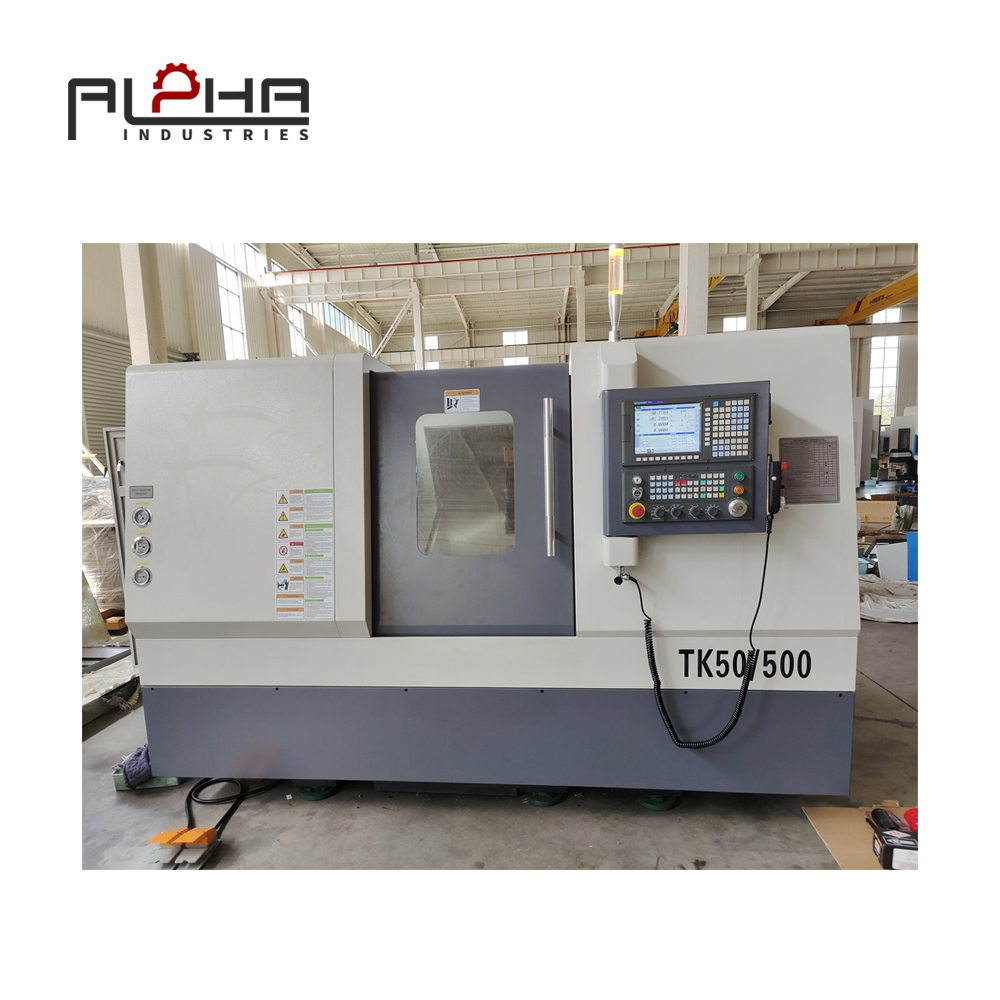
Also known as a slant bed CNC lathe, an inclined bed machine uses a sloped machine-bed structure rather than the traditional horizontal bed design.
The purpose is not simply to make the machine look different.
The inclined structure is designed to improve several aspects of the machining process, particularly chip evacuation, cutting rigidity, tool accessibility, workpiece loading, and automation integration.
For manufacturers in the Americas looking to improve production efficiency, the most important question is therefore not simply whether an inclined bed CNC lathe is technologically advanced.
The more practical question is:
Can an inclined bed CNC lathe help reduce the hidden inefficiencies in our current turning process?
The Real Production Problem: Machine Efficiency Is More Than Cutting Speed
When purchasing a CNC lathe, manufacturers naturally pay attention to spindle speed, spindle power, chuck size, maximum turning diameter, maximum turning length, rapid traverse, and positioning accuracy.
These specifications are important.
However, actual production efficiency depends on much more than cutting parameters.
Consider a typical production environment.
The machine completes a turning cycle, but chips accumulate around the cutting area.
The operator stops the machine.
Chips must be removed.
The workpiece is inspected.
The machine is restarted.
After several hours, chip accumulation becomes a recurring issue.
Over a long production schedule, these small interruptions can become significant.
This is one reason why the machine structure itself should be considered when evaluating production efficiency.
An inclined bed CNC lathe is designed so that chips generated during machining can move downward and away from the cutting zone more naturally.
Instead of allowing chips to remain around horizontal surfaces, the sloped structure encourages gravity-assisted chip movement toward the chip collection area.
This seemingly simple design feature can have a meaningful impact on continuous machining.
Why Chip Evacuation Matters in High-Volume CNC Turning
Chip management is often underestimated when manufacturers compare CNC lathes.
However, chip evacuation can directly influence:
-
Machine uptime
-
Tool life
-
Operator workload
-
Coolant condition
-
Workpiece surface quality
-
Production safety
-
Cleaning requirements
-
Automated production
During metal cutting, the machine may generate a large quantity of chips.
Different materials produce different chip characteristics.
Aluminum can create long or tangled chips under certain cutting conditions.
Stainless steel can produce difficult-to-manage chips.
Mild steel, alloy steel, brass, cast iron, and other materials also behave differently depending on cutting parameters and tooling.
If chips are not evacuated efficiently, they may accumulate around the workpiece or cutting tools.
This can interfere with machining and increase the need for operator intervention.
The inclined bed structure helps direct chips downward.
When combined with an appropriate coolant system and chip conveyor, the machine can create a more efficient chip-management process.
For manufacturers operating multiple shifts, this can be especially valuable.
The Inclined Bed Design and Machining Rigidity
Another major advantage of an inclined bed CNC lathe is its structural design.
The machine bed, guideways, carriage, spindle, and tooling system work together to provide the foundation for cutting operations.
During turning, cutting forces are transmitted through the tool and workpiece into the machine structure.
A rigid machine structure helps maintain stability during machining.
This becomes increasingly important when manufacturers perform:
-
Heavy turning
-
Interrupted cutting
-
High-volume production
-
Hard material machining
-
Threading
-
Grooving
-
Precision finishing
The inclined bed layout can provide a compact structural arrangement in which the tool post and carriage are positioned efficiently relative to the spindle and workpiece.
The result is a machine architecture designed for stable production rather than simply occasional machining.
For manufacturers producing the same components repeatedly, this stability can contribute to more consistent machining results.
Labor Shortage Is Changing How American Manufacturers Buy CNC Machines
One of the biggest challenges facing manufacturers in the Americas is the availability of skilled labor.
A modern CNC lathe does not eliminate the need for skilled personnel.
However, manufacturers can use automation and better machine design to make each operator more productive.
This is an important distinction.
The goal is not necessarily to replace the operator.
The goal is to allow one operator to supervise production more efficiently.
An inclined bed CNC lathe can be integrated with automation systems such as:
-
Automatic bar feeders
-
Robotic loading systems
-
Automatic part unloading
-
Chip conveyors
-
Hydraulic or pneumatic chucks
-
Automatic tool measurement
-
Workpiece probing
-
Parts collection systems
When these systems are properly configured, manufacturers can reduce repetitive manual operations.
The operator can spend more time on:
-
Quality control
-
Tool management
-
Production monitoring
-
Process optimization
-
Multiple-machine supervision
This can be particularly important in regions where manufacturers face difficulties recruiting and retaining experienced CNC operators.
Why Automation Works Well with Inclined Bed CNC Lathes
Automation is becoming increasingly important for manufacturers that want predictable production.
A CNC turning machine equipped with a bar feeder can continuously supply material.
A robotic system can load and unload parts.
A chip conveyor can continuously move machining chips away from the machine.
The combination creates a more integrated production cell.
The inclined bed structure is particularly useful in this environment because the machining area can be designed around efficient material and chip flow.
A typical automated production concept may look like:
Raw Material → Automatic Feeding → CNC Turning → Inspection → Part Collection → Finished Components
The fewer manual interruptions between these stages, the more efficiently the production system can operate.
This is why manufacturers should evaluate an inclined bed CNC lathe as part of the entire production process, rather than as an isolated machine.
Improving Production Efficiency Without Simply Increasing Spindle Speed
Increasing spindle speed is not always the best way to increase productivity.
Higher spindle speed can potentially shorten machining time, but it may also influence:
-
Tool wear
-
Heat generation
-
Surface finish
-
Vibration
-
Power consumption
-
Tool replacement frequency
Real production efficiency is the combination of multiple factors.
A more useful formula is:
Production Efficiency = Cutting Performance + Machine Uptime + Automation + Process Stability
This is where the inclined bed structure becomes relevant.
If chips are removed efficiently, if the machine maintains stable cutting conditions, if automated loading is available, and if operator intervention is reduced, manufacturers can improve production efficiency without relying solely on faster spindle speeds.
For high-volume manufacturers, this broader approach can produce more sustainable productivity improvements.
Inclined Bed CNC Lathe for High-Volume Production
High-volume production requires repeatability.
A manufacturer producing 50 parts is facing a different challenge from a manufacturer producing 50,000 parts.
When production volume increases, even a small inefficiency can become expensive.
For example, suppose a production process loses only a few minutes every hour because of manual cleaning, chip removal, workpiece handling, or tool access.
That time may appear insignificant during a single shift.
Across multiple machines and multiple shifts, however, the lost production time can become substantial.
This is why high-volume manufacturers should examine:
-
Cycle time
-
Loading time
-
Unloading time
-
Tool-change time
-
Cleaning time
-
Inspection time
-
Setup time
-
Downtime
-
Operator intervention
The inclined bed CNC lathe is designed to support a production environment where these factors can be controlled more efficiently.
Better Access to the Machining Area
Machine accessibility is another practical consideration.
Operators need to load components, inspect parts, change tools, maintain the machine, and perform setup operations.
An inclined bed structure can provide a more open and accessible machining area compared with certain traditional machine layouts.
This can simplify routine operations.
For example, when setting up a new component, the operator may need to:
-
Install tooling
-
Set tool offsets
-
Load the workholding system
-
Check the workpiece
-
Adjust coolant
-
Verify the machining program
-
Inspect the first finished component
Good accessibility can make these tasks easier and potentially reduce setup time.
For manufacturers frequently changing production orders, setup efficiency can be just as important as cycle time.
Shorter Setup Time Can Improve Production Flexibility
The Americas include many manufacturers operating in both high-volume and mixed-production environments.
Not every company produces one component continuously.
Some manufacturers receive orders for different part numbers throughout the week.
This creates a need for production flexibility.
A machine that takes too long to change over can lose valuable production capacity.
Manufacturers should therefore evaluate:
How quickly can the machine move from one production job to another?
Important considerations include:
-
Tool accessibility
-
Workholding
-
CNC control
-
Tool presetting
-
Program management
-
Automatic tool measurement
-
Part setup
-
Chip cleaning
-
Operator access
An inclined bed CNC lathe can provide a practical platform for manufacturers that need a combination of production efficiency and flexibility.
Which Industries Can Benefit from Inclined Bed CNC Lathes?
Inclined bed CNC lathes are suitable for a broad range of metalworking applications.
Automotive Parts
Automotive manufacturers and suppliers produce large quantities of turned components.
Applications can include:
-
Shafts
-
Bushings
-
Hubs
-
Pins
-
Flanges
-
Hydraulic components
-
Steering components
-
Transmission parts
High production volume makes cycle time, repeatability, and automation particularly important.
Hydraulic and Pneumatic Components
Hydraulic and pneumatic components often require accurate turning, threading, grooving, and boring.
Typical applications include:
-
Valve bodies
-
Sleeves
-
Connectors
-
Hydraulic fittings
-
Cylindrical components
-
Precision shafts
An inclined bed CNC lathe can provide a stable platform for repetitive turning operations.
General Machinery Components
Many industrial machinery manufacturers require precision turned components.
These may include:
-
Rollers
-
Shafts
-
Bushings
-
Couplings
-
Pins
-
Flanges
-
Machine components
The flexibility of CNC turning makes inclined bed machines suitable for a wide range of industrial applications.
Aerospace Components
Aerospace production requires consistent machining quality and controlled manufacturing processes.
Components may involve difficult materials and demanding tolerances.
For these applications, manufacturers should evaluate machine rigidity, spindle performance, thermal stability, tooling, workholding, and CNC control together.
An inclined bed CNC lathe can be considered for suitable cylindrical and rotational aerospace components.
Energy and Industrial Equipment
Energy-related equipment can involve larger and more demanding turning applications.
Depending on machine size and configuration, inclined bed CNC lathes can be used for components used in:
-
Pumps
-
Valves
-
Industrial machinery
-
Power equipment
-
Oil and gas equipment
-
Process systems
The appropriate machine should always be selected according to the dimensions, material, tolerance, and machining requirements of the component.
Inclined Bed CNC Lathe vs. Flat Bed CNC Lathe
The right machine depends on the application.
| Feature | Inclined Bed CNC Lathe | Flat Bed CNC Lathe |
|---|---|---|
| Chip evacuation | Excellent | Good |
| High-volume production | Excellent | Good |
| Automation integration | Excellent | Good |
| Compact production layout | Excellent | Good |
| Tool accessibility | Excellent | Good |
| Heavy-duty machining | Excellent depending on design | Excellent |
| Small and medium components | Excellent | Good |
| Continuous production | Excellent | Good |
| Manual operation | Suitable | Suitable |
| Flexible turning applications | Excellent | Excellent |
An inclined bed CNC lathe is not necessarily the best choice for every manufacturer.
A flat bed CNC lathe may be more appropriate for certain heavy-duty, large-diameter, or specialized machining applications.
The decision should be based on actual production requirements.
What Should Manufacturers Consider Before Buying an Inclined Bed CNC Lathe?
Machine selection should begin with the component.
Before contacting a machine supplier, manufacturers should prepare information about:
Part Diameter
What is the maximum and minimum turning diameter?
Part Length
What is the maximum machining length?
Material
Will the machine process steel, stainless steel, aluminum, brass, cast iron, titanium, or other materials?
Tolerance
What dimensional and geometric tolerances are required?
Production Volume
How many parts need to be produced per day, month, or year?
Machining Operations
Will the machine perform turning only, or also drilling, boring, threading, grooving, milling, or other operations?
Automation
Will automatic feeding, robotic loading, or parts collection be required?
Workholding
What chuck, collet, fixture, or hydraulic workholding system is appropriate?
Chip Management
What type of chips will the machining process generate?
After-Sales Service
What level of technical support, spare parts, training, installation, and maintenance assistance is available?
These factors provide a much stronger basis for machine selection than comparing purchase prices alone.
The Hidden Cost of Buying the Wrong CNC Lathe
A low machine price does not necessarily mean a low production cost.
Imagine two machines.
Machine A costs less but requires more manual intervention.
Machine B costs more but provides better automation, chip evacuation, accessibility, and production stability.
If Machine B produces more parts per shift with fewer interruptions, its total manufacturing cost may eventually be lower.
This is why manufacturers should evaluate Total Cost of Ownership (TCO).
TCO can include:
-
Purchase cost
-
Installation
-
Tooling
-
Labor
-
Electricity
-
Maintenance
-
Spare parts
-
Downtime
-
Scrap
-
Tool consumption
-
Production capacity
A machine should therefore be evaluated based on the value it creates over its operating life.
How ALPHA Approaches Inclined Bed CNC Lathe Solutions
At ALPHA, we understand that every manufacturer has different production requirements.
A CNC lathe for a small automotive component may require a completely different configuration from a machine designed for large industrial components.
The ideal machine depends on the actual application.
ALPHA can help customers evaluate factors such as:
-
Workpiece dimensions
-
Material characteristics
-
Production volume
-
Required tolerances
-
Machining operations
-
Spindle requirements
-
Tooling configuration
-
Workholding
-
Automation
-
Chip removal
-
Production efficiency
The goal is not simply to provide a machine.
The goal is to help customers build a more efficient and reliable turning process.
For manufacturers in the Americas, this approach can be particularly useful when the objective is to improve productivity while controlling labor and operating costs.
Frequently Asked Questions About Inclined Bed CNC Lathes
What is an inclined bed CNC lathe?
An inclined bed CNC lathe is a computer-controlled turning machine that uses a sloped machine-bed structure. The design helps improve chip evacuation, machining accessibility, structural rigidity, and suitability for automated production.
What is the difference between an inclined bed and a flat bed CNC lathe?
The primary difference is the machine-bed structure. An inclined bed uses a sloped design that helps chips move away from the cutting area and can provide a compact machining structure. A flat bed uses a more traditional horizontal bed configuration.
Why are inclined bed CNC lathes popular for production machining?
Their structural design supports efficient chip evacuation, good tool accessibility, stable cutting, and automation integration. These characteristics make them suitable for repetitive and high-volume turning applications.
Can an inclined bed CNC lathe be automated?
Yes. Depending on the machine configuration, it can be integrated with bar feeders, robotic loading systems, automatic part unloading, chip conveyors, probing systems, and other automation equipment.
Are inclined bed CNC lathes suitable for high-volume production?
Yes. They are widely suited to repetitive production because their design can support automation, efficient chip removal, stable machining, and reduced operator intervention.
Can an inclined bed CNC lathe machine different materials?
Yes. Depending on machine configuration, tooling, spindle specifications, and cutting conditions, inclined bed CNC lathes can process materials such as steel, stainless steel, aluminum, brass, cast iron, and various engineering materials.
Does an inclined bed CNC lathe reduce labor costs?
It can reduce manual handling and operator intervention, especially when combined with automatic loading, bar feeding, chip removal, and other automation systems. Actual labor savings depend on the production process.
How do I choose the right inclined bed CNC lathe?
Evaluate your workpiece diameter, machining length, material, tolerances, production volume, required operations, spindle requirements, tooling, workholding, automation, and expected cycle time before selecting a machine.
Conclusion: The Real Advantage Is a More Efficient Turning Process
For manufacturers in the Americas, improving CNC turning productivity is not simply about increasing spindle speed.
The bigger opportunity is to improve the entire production process.
An inclined bed CNC lathe can contribute to this objective through its sloped machine-bed structure, efficient chip evacuation, stable machining configuration, accessible working area, and compatibility with automated production systems.
When combined with automatic material feeding, efficient tooling, reliable workholding, chip conveyors, and appropriate process planning, an inclined bed CNC lathe can become an important part of a modern manufacturing cell.
For companies facing labor shortages, rising operating costs, increasing customer expectations, and pressure to improve delivery times, these advantages can become particularly valuable.
The right CNC lathe is not simply the machine with the highest specifications.
It is the machine that solves the actual problems in your production process.
Contact Us
Are you looking for a reliable Inclined Bed CNC Lathe for your production requirements?
Whether you are machining automotive components, hydraulic parts, shafts, bushings, industrial components, or other precision turned parts, ALPHA can help you evaluate the right CNC turning solution according to your workpiece, material, production volume, tolerance requirements, and automation needs.
Contact ALPHA today to discuss your inclined bed CNC lathe requirements and find a suitable solution for your manufacturing process.