

Why VMC Component Compatibility Matters in the Russian Market
A vertical machining center is a long-term production investment. Once installed, it becomes an important part of a workshop's daily manufacturing process, producing components for machinery, automotive applications, industrial equipment, metal fabrication, and other sectors.
For Russian manufacturers, choosing a VMC involves more than deciding on table dimensions, spindle speed, axis travel, and machining accuracy. The availability and compatibility of critical machine components also deserve careful attention.
International supply chains have changed significantly in recent years. Access to certain imported machine-tool components, technical services, and replacement parts can be more complicated than before. Russian machine-tool manufacturers and users continue to face challenges related to imported components and technological dependence.
This does not mean that every imported VMC will experience supply difficulties. The actual situation depends on the machine configuration, component manufacturers, supplier arrangements, import channels, and the support resources available to the buyer.
However, purchasing decisions should consider the complete technical configuration rather than focusing only on the machine's initial price.
A VMC may offer attractive machining performance, but if the buyer cannot identify its main components, obtain the necessary technical documentation, or confirm a suitable replacement route, long-term equipment management can become more complicated.
For Russian buyers, one important purchasing question is:
Can this VMC be maintained, supported, and operated reliably throughout its expected service life?
This article explains how to evaluate that question before placing an order.
Understand the Critical Components of a VMC Before Purchasing
A VMC is an integrated machining system. Its performance depends on the coordination of mechanical structures, electrical components, CNC software, drive systems, and auxiliary equipment.
When evaluating a machine, buyers should identify the main components and understand their functions.
CNC Controller: The Core of Machine Operation
The CNC controller is responsible for interpreting machining programs and coordinating machine movements.
It controls important functions such as:
-
X-, Y-, and Z-axis positioning
-
Spindle speed commands
-
Feed rate control
-
Tool changes
-
Coordinate systems
-
Machine alarms
-
Program execution
-
Operator-machine communication
Different CNC controllers may use different programming formats, parameter structures, communication interfaces, and operating procedures.
Before purchasing a VMC, buyers should confirm the exact controller manufacturer and model.
They should also request information about:
-
Standard CNC functions
-
Available machining cycles
-
Supported program formats
-
Tool and work coordinate management
-
Data backup procedures
-
Parameter backup and recovery
-
Network or data transfer options
-
Language options, where available
The controller should match the workshop's programming capabilities and production requirements.
If the factory already operates CNC equipment using a particular control system, choosing a compatible or familiar platform may reduce the time needed for operator training and process adaptation.
However, buyers should not assume that two controllers from the same manufacturer have identical functions or parameter structures. The exact model and software configuration matter.
Servo Drives and Motors: Confirm the Complete Drive Configuration
Servo motors and drives control the movement of the machine axes. Their performance influences positioning, acceleration, feed movement, and overall machining stability.
When evaluating a VMC, buyers should confirm:
-
Servo motor manufacturer and model
-
Servo drive manufacturer and model
-
Rated motor power
-
Feedback and encoder configuration
-
Drive communication requirements
-
Available diagnostic information
-
Replacement identification details
The servo system should be considered together with the CNC controller.
A replacement drive or motor cannot be selected only by comparing rated power. Electrical interfaces, feedback devices, communication protocols, mechanical dimensions, and control parameters may also need to match.
For this reason, accurate component identification is important for future maintenance.
Spindle Assembly: Evaluate More Than Maximum RPM
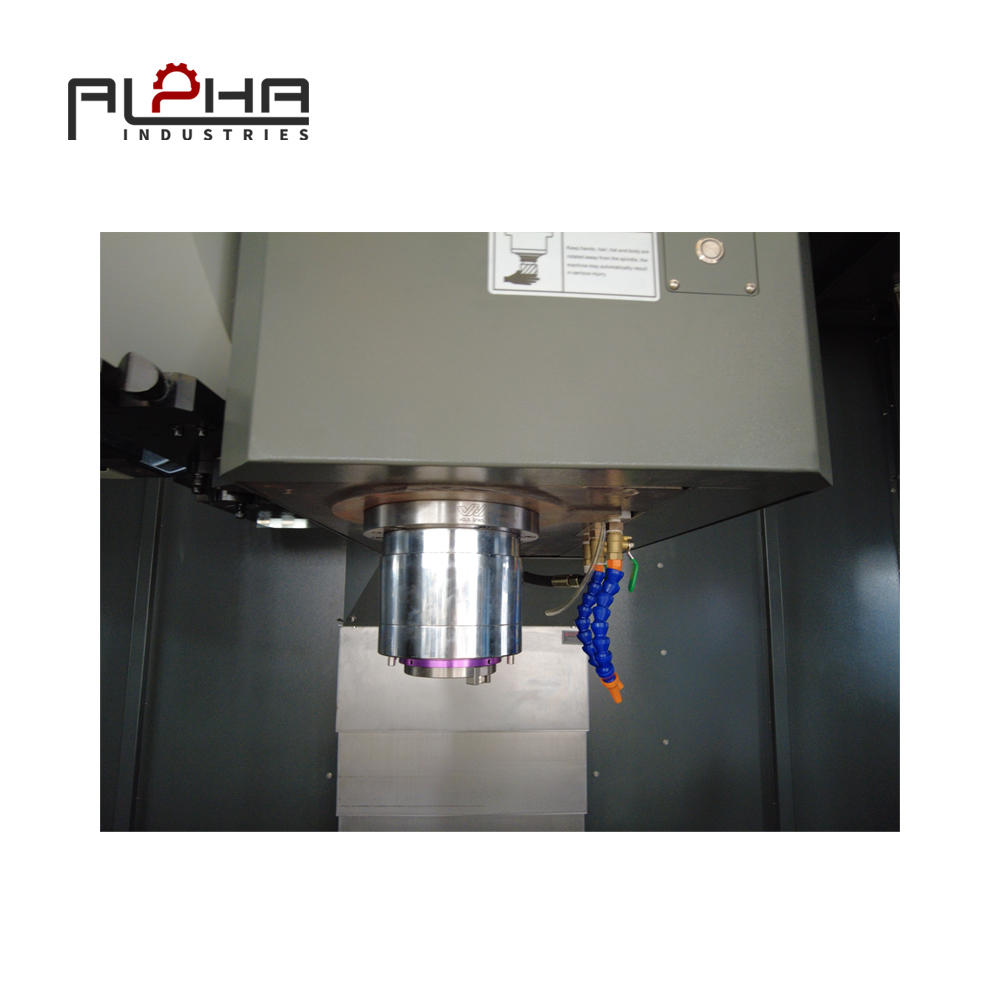
The spindle is one of the most important components of a vertical machining center. It directly influences cutting capability, tool compatibility, machining accuracy, and the types of materials that the machine can process.
Buyers should examine:
-
Spindle type
-
Maximum spindle speed
-
Available torque characteristics
-
Spindle motor configuration
-
Tool interface
-
Cooling arrangement
-
Lubrication requirements
-
Maintenance instructions
A machine with a high maximum spindle speed is not automatically suitable for every application.
For heavy steel milling, available torque at the required speed may be more important than maximum RPM.
For higher-speed machining, spindle balance, thermal behavior, tool holding, and operating conditions should also be considered.
The spindle configuration should be selected according to the actual materials, tools, and machining operations used by the workshop.
Linear Guideways and Ball Screws: Check Identification and Specifications
Linear guideways and ball screws are essential components of the machine's axis movement system.
Their specifications influence movement stability, positioning behavior, rigidity, and long-term mechanical performance.
Buyers should request the relevant technical information, including:
-
Guideway manufacturer and series
-
Guideway size
-
Ball screw diameter and lead
-
Ball screw support arrangement
-
Lubrication requirements
-
Installation and maintenance information
It is also useful to understand whether the machine uses roller-type or ball-type linear guides, and how the selected configuration matches the machine structure and machining requirements.
When future replacement is necessary, identifying the exact series and dimensions can make component selection more straightforward.
Automatic Tool Changer: Check the Complete System
An automatic tool changer is important for production involving multiple cutting operations.
A VMC may use different ATC configurations depending on the machine size and application.
Buyers should confirm:
-
Tool magazine type
-
Tool capacity
-
Maximum tool diameter
-
Maximum tool length
-
Maximum tool weight
-
Tool interface
-
Tool change sequence
-
Maintenance requirements
The buyer should also request the tool magazine manufacturer's information, where available.
A complete understanding of the ATC configuration helps prevent misunderstandings about tool compatibility and future maintenance.
Confirm Component Availability and Replacement Compatibility
For Russian buyers, one of the most important steps before purchasing a VMC is to understand how its critical components can be identified and replaced.
A supplier's statement that replacement parts are available is useful, but it should be supported by specific technical information.
Request a Main Component List
Ask the supplier to provide a component list showing the main systems installed on the machine.
A useful list may include:
|
Component |
Information to Confirm |
|---|---|
|
CNC controller |
Manufacturer, model, software configuration |
|
Servo motors |
Manufacturer, model, rated power |
|
Servo drives |
Model, interface, compatible motor |
|
Spindle |
Type, speed range, tool interface |
|
Spindle motor |
Manufacturer, model, power |
|
Linear guideways |
Manufacturer, series, size |
|
Ball screws |
Diameter, lead, manufacturer |
|
ATC |
Magazine type, capacity, configuration |
|
Lubrication system |
Pump type, lubrication requirements |
|
Coolant system |
Pump configuration, operating requirements |
The list should describe the actual machine being quoted or manufactured.
If the supplier offers several configuration options, the buyer should request a revised component list for the selected version.
This is particularly important when comparing quotations from different manufacturers.
Two VMCs may have similar external dimensions and spindle specifications but use different internal components. Without a clear component list, it can be difficult to make an accurate technical comparison.
Distinguish Standard Components from Optional Components
Some machine configurations include standard components, while others require additional options.
For example, a particular controller, spindle configuration, tool magazine, chip conveyor, or cooling system may not be included in the standard quotation.
Buyers should confirm:
-
Which components are included in the quoted price
-
Which components are optional
-
Whether alternative brands are available
-
Whether a component change affects the machine's performance
-
Whether the final configuration will be recorded in the contract
This reduces the risk of receiving a machine that differs from the buyer's original technical expectations.
Understand the Difference Between Similar Specifications and Actual Compatibility
Two components may have similar dimensions or rated power but still be incompatible.
For example, servo motors with similar power ratings may use different encoder systems or drive interfaces.
Likewise, a spindle with the same maximum speed may have a different tool interface, cooling method, or mounting arrangement.
When requesting replacement information, buyers should provide the complete model number and relevant technical specifications rather than relying on general descriptions.
For critical components, compatibility should be confirmed by the component manufacturer or a technically qualified supplier.
Evaluate CNC Control System Compatibility with Existing Workshop Equipment
Many Russian manufacturers already operate CNC lathes, milling machines, machining centers, or other automated equipment.
When adding a new VMC, compatibility with existing production methods can help simplify the transition.
Review Existing CNC Programming Experience
If operators and programmers already use a particular CNC control platform, a familiar system may reduce the learning curve.
However, the actual training requirement depends on the controller model, software version, machine functions, and operator experience.
Before ordering, buyers should clarify:
-
Whether existing CNC programs can be adapted
-
Whether postprocessors are required
-
Whether the controller supports the required machining cycles
-
Whether program transfer methods are compatible
-
Whether the supplier can provide sample programs or operating instructions
For companies using CAD/CAM software, postprocessor compatibility is particularly important.
A postprocessor converts machining instructions into code that can be understood by the selected CNC controller.
A machine may have suitable mechanical performance, but an unsuitable postprocessor can create additional programming and commissioning work.
Confirm CAD/CAM and Data Transfer Requirements
Different workshops use different design and manufacturing software.
Before purchasing a VMC, the buyer should identify the software used for:
-
2D engineering drawings
-
3D part modeling
-
CAM toolpath generation
-
CNC program simulation
-
Production documentation
The buyer should then confirm how programs will be transferred to the machine.
Possible methods include approved network connections, USB storage, or other supported interfaces.
The selected method should comply with the machine manufacturer's technical requirements and the workshop's IT policies.
Check Parameter Backup and Recovery Procedures
CNC parameters are important for machine configuration and operation.
A proper backup procedure can help the workshop restore settings after certain maintenance or control-system service operations.
Buyers should ask:
-
How are CNC parameters backed up?
-
Can machine data be exported?
-
What documentation is supplied?
-
Who is authorized to restore parameters?
-
Are controller-specific backup tools required?
A clear backup and recovery procedure is especially valuable when the machine will operate in a facility without immediate access to the original equipment supplier.
Technical Documentation: A Critical Part of Long-Term VMC Ownership
A VMC is not simply a machine delivered to a factory. It is a technical system that requires installation, operation, inspection, and maintenance.
Documentation helps the workshop understand the equipment and communicate accurately with the supplier.
For this reason, technical documents should be considered part of the purchasing requirements.
Request Complete Machine Documentation
Before shipment, buyers should clarify which documents will be supplied.
A suitable documentation package may include:
Mechanical documentation
-
General arrangement drawing
-
Machine installation dimensions
-
Foundation requirements, where applicable
-
Main mechanical assembly information
-
Lubrication points and requirements
-
Maintenance access information
Electrical documentation
-
Electrical circuit diagrams
-
Main electrical component list
-
Wiring information
-
Control cabinet layout
-
Relevant safety information
CNC and operating documentation
-
CNC operating manual
-
Machine operation instructions
-
CNC parameter backup information
-
Alarm and troubleshooting references
-
Tool magazine operating instructions
Maintenance documentation
-
Recommended inspection items
-
Lubrication instructions
-
Coolant maintenance requirements
-
Routine maintenance procedures
-
Relevant replacement component identification
The exact documentation package depends on the machine configuration and supplier arrangement.
Buyers should confirm the final document list in writing rather than assuming that every supplier provides identical materials.
Confirm Language Requirements
Language is an important practical issue for machine installation and operator training.
If the production team primarily uses Russian, buyers should discuss the availability of Russian-language manuals, labels, or training materials.
If the supplier provides documentation in English, the buyer should determine whether internal technical staff can use it effectively.
For important safety and operating instructions, the workshop should ensure that the responsible personnel understand the content before operating the machine.
Keep Documentation Consistent with the Delivered Machine
A technical document is only useful when it matches the actual equipment.
If the supplier changes the controller, spindle, drive system, or another important component during production, the final component list and relevant documentation should reflect the delivered configuration.
Buyers should request the final approved machine configuration before shipment.
This helps maintenance staff identify the correct components and reduces confusion during future technical communication.
Evaluate Supplier Support Before Making a Purchase Decision
The supplier's ability to provide clear technical information is an important part of the VMC purchasing process.
A supplier does not necessarily need to provide every service directly. However, the buyer should understand which support resources are available and which responsibilities belong to other parties.
Ask About Technical Communication
Before placing an order, discuss how technical questions will be handled.
Useful questions include:
-
Who is the main technical contact?
-
Can the supplier communicate with the buyer's maintenance team?
-
Are remote troubleshooting sessions available?
-
Can electrical diagrams and component lists be provided?
-
Is operator training included?
-
What information is required when reporting a machine alarm?
A clear communication process can make it easier to resolve technical questions after installation.
Confirm Warranty Scope and Responsibilities
Warranty terms should be reviewed carefully.
Buyers should confirm:
-
Warranty period
-
Which machine components are covered
-
Which parts are considered consumables
-
How warranty claims are submitted
-
What documents are required
-
Who pays transportation costs for replacement parts
-
Whether labor and remote support are included
Do not assume that the warranty covers every component or every type of failure.
The written contract should define the coverage and responsibilities clearly.
Understand the Difference Between Remote Support and On-Site Service
Some technical issues can be investigated through photographs, videos, electrical diagrams, alarm information, and remote communication.
Other issues may require physical inspection by qualified technicians.
Before purchasing, buyers should ask what types of support are available and whether local service arrangements exist.
For Russian customers, the feasibility of technician travel, communication, and parts delivery should be evaluated according to the specific supplier and order arrangement.
Avoid relying on general promises such as "lifetime service" without understanding the actual scope.
Evaluate the Supplier's Response Process
A supplier's technical response should be practical and specific.
For example, when reporting an alarm, the buyer may need to provide:
-
Machine model
-
CNC controller model
-
Alarm number and description
-
Photographs of the control screen
-
Relevant machine operating conditions
-
Recent maintenance or parameter changes
A supplier with a clear technical communication process can help the buyer provide the information needed for troubleshooting.
Spare Parts Planning Should Start Before the Machine Arrives
Although component availability should be evaluated during purchasing, spare parts planning is a separate practical step.
The objective is not to purchase every possible replacement component.
Instead, the buyer should understand which parts are critical, how they are identified, and how they can be sourced if required.
Separate Critical Components from Routine Consumables
Different components have different replacement cycles and operational importance.
A practical classification may include:
|
Category |
Examples |
Purchasing Consideration |
|---|---|---|
|
Routine consumables |
Filters, lubricants, coolant-related consumables |
Confirm specifications and suitable supply sources |
|
Common electrical parts |
Fuses, relays, selected sensors |
Confirm exact models and electrical ratings |
|
Mechanical components |
Belts, seals, selected bearings |
Confirm dimensions and machine configuration |
|
Specialized components |
CNC controller, spindle, servo drive |
Confirm technical compatibility and supplier support |
This classification is a starting point, not a universal spare parts list.
The actual spare parts strategy should be based on the selected VMC configuration, operating conditions, supplier recommendations, and the workshop's maintenance capabilities.
Request Part Numbers and Identification Information
When a component needs replacement, a complete identification record can reduce communication time.
Where available, the buyer should retain:
-
Component manufacturer
-
Complete model number
-
Serial number
-
Electrical or mechanical specifications
-
Installation location
-
Relevant drawings
-
Supplier contact information
Photographs of component labels can also be useful.
However, photographs should support rather than replace accurate model identification.
Check Whether Alternative Components Are Technically Approved
In some situations, a buyer may consider an alternative component from another manufacturer.
This should never be based only on appearance, dimensions, or rated power.
The replacement must be checked for electrical, mechanical, software, and performance compatibility.
For CNC control systems, servo drives, and spindle assemblies, unauthorized substitutions may affect machine functions or require additional engineering work.
Any proposed replacement should be approved by a qualified technical party and documented appropriately.
Check Installation and Commissioning Requirements in Advance
A VMC's long-term performance depends not only on the machine itself but also on correct installation and commissioning.
Russian workshops should review site preparation requirements before the machine is delivered.
Confirm Workshop Power Supply
The buyer should verify the machine's electrical requirements.
Relevant information includes:
-
Rated voltage
-
Frequency
-
Phase requirements
-
Connected load
-
Recommended circuit protection
-
Grounding requirements
-
Other site electrical conditions specified by the manufacturer
The actual requirements should be taken from the final machine documentation.
Do not assume that two VMCs with similar spindle power have identical electrical requirements.
Review Foundation and Installation Conditions
Machine installation requirements vary according to machine size, weight, structure, and design.
Before delivery, the workshop should review:
-
Machine footprint
-
Total machine weight
-
Foundation requirements
-
Floor loading capacity
-
Access for unloading
-
Transportation route inside the factory
-
Required installation clearance
For larger machining centers, the unloading and positioning plan should be prepared before shipment.
Confirm Environmental Conditions
The workshop environment can influence machine operation and long-term stability.
Buyers should review the manufacturer's specified operating conditions, including:
-
Ambient temperature range
-
Humidity requirements
-
Floor conditions
-
Dust and contamination
-
Ventilation
-
Cooling requirements
Where the workshop experiences significant seasonal temperature changes, the machine should be operated and maintained according to the manufacturer's environmental and warm-up recommendations.
Prepare Operator and Maintenance Training
Before production begins, operators and maintenance personnel should understand the machine's basic functions.
Training should cover:
-
Machine startup and shutdown
-
CNC program loading
-
Workpiece setup
-
Tool installation
-
Tool offset management
-
Alarm handling
-
Lubrication checks
-
Routine inspection
-
Safe operating procedures
The training scope should be confirmed before purchase.
Compare VMC Suppliers Using a Technical Evaluation Checklist
A purchasing decision should not depend on price alone.
A technical comparison helps identify differences between machine configurations and supplier capabilities.
The following checklist can be used when evaluating several VMC quotations.
|
Evaluation Area |
Questions to Ask |
|---|---|
|
Machine structure |
What is the machine configuration and structural design? |
|
CNC controller |
Which manufacturer and model are installed? |
|
Servo system |
Are the motor and drive models clearly identified? |
|
Spindle |
What are the speed, torque, tool interface, and cooling arrangements? |
|
Axis system |
Which guideways and ball screws are used? |
|
Tool magazine |
What is the ATC type and tool capacity? |
|
Electrical system |
What are the voltage and connected-load requirements? |
|
Documentation |
Are mechanical, electrical, and operating manuals included? |
|
Language |
Which languages are available for manuals and training? |
|
Warranty |
What components and services are covered? |
|
Technical support |
What remote or local support arrangements are available? |
|
Spare parts |
Can the supplier identify and quote critical replacement parts? |
|
Delivery |
What is included in the shipment and installation scope? |
Buyers can also request a technical clarification sheet for every quotation.
This makes it easier to compare machines on an equivalent basis.
A supplier that provides detailed technical information may help the buyer understand the actual machine configuration more clearly than a quotation containing only general specifications.
Questions Russian Buyers Should Ask Before Ordering a VMC
The following questions can help buyers evaluate whether a machine is suitable for long-term production.
Can the Supplier Provide a Complete VMC Component List?
The buyer should request the main component brands, models, and specifications.
This information helps the maintenance team identify the machine configuration and evaluate future replacement requirements.
Is the CNC Controller Suitable for Our Existing Production Process?
The buyer should compare the proposed controller with existing programming methods, CAD/CAM software, and operator experience.
If necessary, request confirmation of postprocessor availability and program transfer methods.
Are Electrical and Mechanical Drawings Included?
The buyer should confirm which technical documents will be delivered and whether they correspond to the final machine configuration.
Can We Obtain the Exact Models of Critical Components?
The buyer should request the model numbers of the CNC controller, servo drives, spindle system, guideways, ball screws, and other important components.
What Technical Support Is Available After Delivery?
The supplier should explain the available communication channels, remote support arrangements, training scope, and warranty process.
Can the Supplier Recommend a Suitable Spare Parts Strategy?
A supplier familiar with the machine configuration should be able to identify important components and explain their specifications.
Can the Machine Be Tested Before Shipment?
Where possible, buyers should request a machine inspection or acceptance test.
The inspection can cover the machine's basic functions, axis movement, spindle operation, tool changing, CNC control, and agreed machining tests.
The specific acceptance criteria should be defined in the purchase agreement.
Why a Detailed VMC Purchasing Process Helps Reduce Long-Term Risk
A VMC purchase affects more than the initial equipment budget.
It also influences production planning, operator training, maintenance procedures, and the workshop's future technical capabilities.
A well-organized purchasing process can help manufacturers avoid several common problems.
Unclear Machine Configuration
Without a detailed component list, the buyer may not know exactly which controller, spindle, drive system, or mechanical components are included.
Difficult Technical Communication
Without model numbers and technical documentation, maintenance staff may struggle to describe a problem accurately.
Unexpected Compatibility Issues
Replacing components based only on similar dimensions or ratings may create additional technical difficulties.
Insufficient Operator Preparation
A machine can arrive on schedule but still require additional time for training and programming adaptation.
Unclear Warranty Responsibilities
If the warranty scope and service process are not defined in advance, both buyer and supplier may face misunderstandings.
These risks can be reduced by confirming technical details before production, documenting the final machine configuration, and establishing clear responsibilities for delivery, installation, training, and after-sales communication.
Frequently Asked Questions About Buying a VMC in Russia
What should Russian manufacturers check before buying a VMC?
Russian manufacturers should evaluate the machine structure, CNC controller, spindle, servo drives, guideways, ball screws, tool magazine, electrical requirements, technical documentation, warranty, and supplier support. Component identification and long-term serviceability should be considered alongside machining performance and price.
Why is CNC component compatibility important when purchasing a VMC?
Different CNC components may have different electrical interfaces, communication protocols, software configurations, mechanical dimensions, and performance characteristics. Confirming compatibility helps the buyer understand future maintenance and replacement requirements.
Which VMC components should buyers identify before ordering?
Important components include the CNC controller, servo motors, servo drives, spindle assembly, spindle motor, linear guideways, ball screws, automatic tool changer, lubrication system, and coolant system. The exact list depends on the selected machine configuration.
What documents should be supplied with a VMC?
A typical documentation package may include mechanical drawings, electrical diagrams, component lists, operating manuals, CNC instructions, lubrication requirements, maintenance information, and relevant installation documents. Buyers should confirm the exact document list in the purchase agreement.
Can an existing CNC program be used on a new VMC?
Possibly, but compatibility depends on the CNC controller, programming format, machine configuration, and postprocessor. Existing programs may need to be checked or modified before production.
How can buyers evaluate the after-sales support of a VMC supplier?
Buyers should ask about technical contacts, remote troubleshooting, operator training, warranty coverage, component identification, replacement part sourcing, and the availability of local service arrangements. The responsibilities and service scope should be clearly documented.
Is a VMC with well-known component brands always the best choice?
Not necessarily. Recognized component brands can be useful, but buyers should also consider the actual model, technical compatibility, machine integration, application requirements, documentation, and support arrangements. The complete machine configuration matters more than a list of brand names.
What should be included in a VMC acceptance inspection?
An acceptance inspection may include machine appearance, electrical functions, axis movement, spindle operation, tool changing, CNC control functions, safety devices, and agreed machining tests. The inspection scope and acceptance criteria should be confirmed before production.
Why should buyers confirm the final component list before shipment?
The final component list records the actual machine configuration. It helps the buyer's maintenance team identify installed components, check documentation, communicate with the supplier, and prepare appropriate technical records for future service.
Conclusion: Select a VMC with Both Machining Performance and Long-Term Support in Mind
For Russian manufacturers, purchasing a vertical machining center is a decision that should be based on both immediate production requirements and long-term equipment management.
A machine's spindle speed, axis travel, table dimensions, and machining accuracy are important. However, the CNC controller, servo system, spindle configuration, guideways, ball screws, technical documentation, and supplier support also influence the overall ownership experience.
Before placing an order, buyers should request a clear component list, confirm control system compatibility, review the technical documents, understand the warranty scope, and establish a practical communication process with the supplier.
A transparent machine configuration makes it easier to plan installation, train operators, identify components, and manage future maintenance.
At ALPHA, we understand that selecting industrial machinery requires careful consideration of the customer's actual production needs and machine configuration.
If you are looking for a VMC for your factory in Russia, our team can discuss your workpiece dimensions, material requirements, machining operations, spindle specifications, CNC control preferences, and production targets.
Contact ALPHA to discuss a suitable vertical machining center for your manufacturing requirements.
Contact Us: https://alpha-cnc.com/contact-us