

Why Complex Bending Jobs Require More Than a Powerful Press Brake
For sheet metal manufacturers in Ukraine, choosing a press brake with sufficient tonnage and bending length is only the beginning. The machine must also be capable of producing the required component geometry without unnecessary setup changes, repeated adjustments, or interference between the workpiece and machine components.
This becomes particularly important when manufacturing complex sheet metal parts.
Electrical enclosures, industrial equipment housings, agricultural machinery components, construction equipment brackets, control cabinets, and customized metal structures may require several bends in different directions. As each flange is formed, the shape of the workpiece changes, creating new restrictions on how the component can be positioned for the next operation.
A bending sequence that works for a simple bracket may not work for a large enclosure with multiple flanges. A long flange may interfere with the upper beam, a previously formed edge may hit the tooling, or the workpiece may become difficult to rotate after several bends have been completed.
These problems can lead to more than an inconvenient production cycle. A collision may damage the workpiece, tooling, or machine components. Even when no damage occurs, operators may need to stop production, remove the part, revise the setup, and repeat the operation.
For Ukrainian manufacturers managing customized production, changing order requirements, and pressure to maintain delivery schedules, these interruptions can create unnecessary cost and uncertainty.
The key question is not simply how much force a press brake can generate. It is whether the selected machine and planned bending process can form the required geometry reliably.
Preventing bending collisions starts with understanding the complete part geometry before production begins.
Understanding the Main Types of Press Brake Collisions
A press brake collision occurs when the workpiece, tooling, machine structure, or another component comes into unintended contact during a bending operation or workpiece repositioning.
Some collisions are obvious. Others begin as clearance problems that force operators to change their working method or abandon the planned sequence.
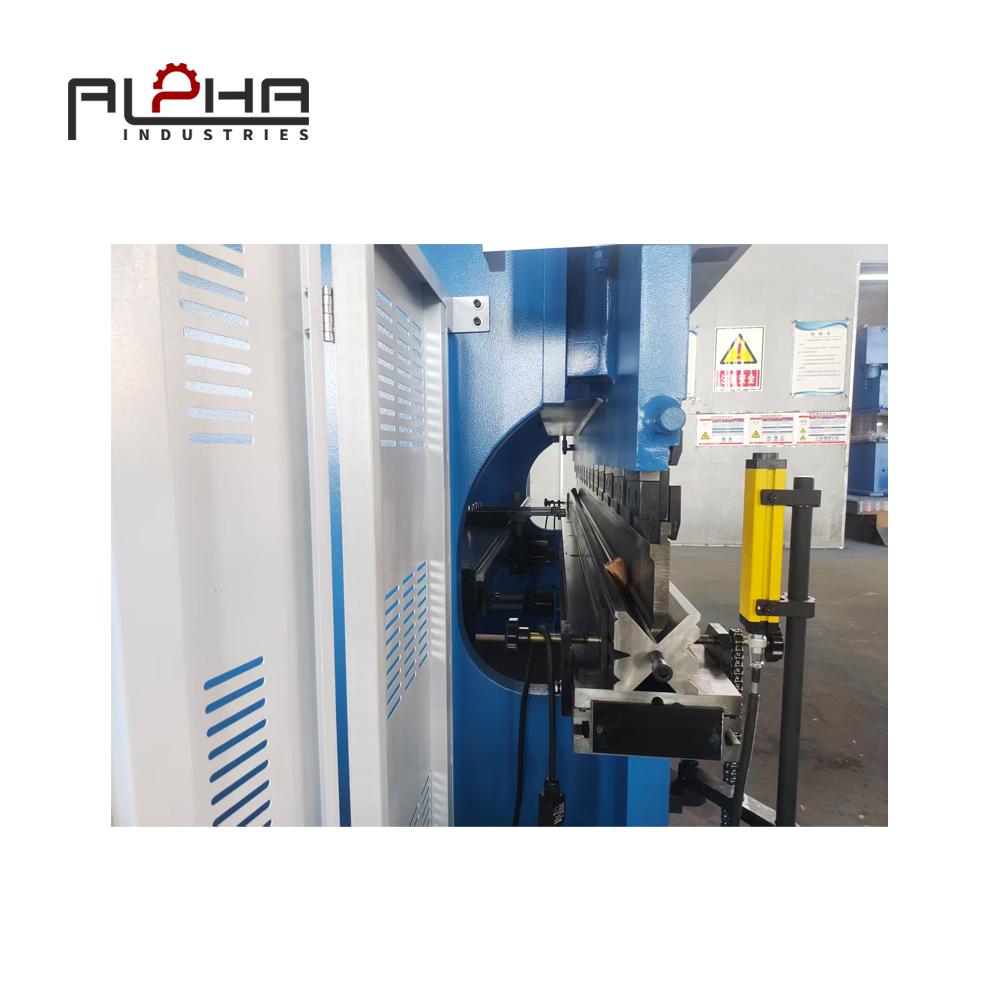
Workpiece Collision With the Upper Beam
During bending, the workpiece moves in relation to the upper beam, punch, and die. As a flange becomes larger or the part geometry becomes more complicated, the formed component may approach the machine structure.
If the workpiece does not have sufficient clearance, the flange may contact the upper beam or another machine component before the bend is completed.
This risk is especially relevant when producing deep boxes, large panels, components with tall flanges, and parts that require several bends close together.
The problem cannot always be solved by reducing bending force or slowing the machine. The operator may need a different bend sequence, a different tooling arrangement, or a machine configuration with more suitable geometry.
Collision Between the Workpiece and Tooling
Tooling interference can occur when a previously formed flange obstructs the punch or die required for the next bend.
For example, a component may have two adjacent flanges that must be formed at different angles. If the first flange is bent in the wrong sequence, it may prevent the punch from reaching the intended position for the second operation.
In such cases, the workpiece may need to be rotated or approached from another direction. If the part cannot be repositioned safely, the original sequence may be unsuitable.
This is why tooling selection and bend sequencing should be considered together rather than as separate preparation tasks.
Backgauge Interference
The backgauge helps position the workpiece accurately before bending. However, complex parts may contain flanges or formed sections that interfere with the backgauge fingers or support components.
A previously formed flange may prevent the sheet from resting correctly against the programmed reference position. The operator may then need to reposition the workpiece manually or change the support arrangement.
This can affect both production efficiency and dimensional consistency.
For parts with unusual geometry, manufacturers should verify the relationship between the workpiece, backgauge configuration, and bending sequence before starting the full production batch.
Collision During Workpiece Rotation
Some components require repeated rotation or repositioning between bends. As the part becomes more complex, its center of gravity, available gripping areas, and overall dimensions can change.
A flange that clears the tooling in one orientation may interfere with the machine when the part is rotated for the next operation.
Large components can also require more space around the machine, making it difficult to reposition the workpiece without contacting nearby equipment or other objects.
Manufacturers should therefore evaluate not only the bending stroke itself but also the movements required to transfer the part from one operation to the next.
Why Collision Prevention Matters for Ukrainian Manufacturers
Ukraine's metalworking sector serves diverse applications, including agricultural machinery, construction equipment, electrical cabinets, industrial machinery, infrastructure-related components, and general sheet metal fabrication.
These applications often involve a mix of standard products and customized components. One production order may contain simple flat brackets, while another may require deep enclosures, irregular flanges, or multiple bends in a single workpiece.
This variation makes production planning important.
A collision or an unsuitable bending sequence can interrupt a job that was expected to move quickly through the workshop. If the affected component is part of a larger assembly, the delay may also affect welding, finishing, inspection, and final delivery.
For manufacturers working with limited production capacity, even a short interruption can create additional scheduling pressure.
Several factors make collision prevention particularly valuable:
-
Customized component geometry: Different designs may require different bending sequences and tooling arrangements.
-
Variable batch sizes: Short production runs leave less room for repeated trial-and-error setup.
-
Pressure on material costs: A damaged component may require additional material and production time.
-
Delivery commitments: Delays at the bending stage can affect downstream operations.
-
Operator experience: Complex jobs may require detailed process knowledge that is not shared equally across the workforce.
-
Machine investment decisions: Buyers need to understand whether the proposed machine can accommodate their actual component geometry.
These challenges do not mean that every Ukrainian manufacturer needs a fully automated bending cell. In many cases, better process planning, suitable tooling, and the correct machine configuration can address a significant part of the problem.
Bend Sequencing: The First Step in Preventing Collisions
Bend sequencing determines the order in which the individual bends are performed.
For a simple component, the sequence may be straightforward. For a complex component, however, the order of operations can determine whether the part can be completed efficiently at all.
Start With the Finished Part Geometry
Before deciding the bend sequence, review the finished component drawing.
Identify the number of bends, flange heights, bend directions, internal clearances, hole positions, and any formed features that may obstruct later operations.
The designer or process engineer should also consider the material thickness, required bend radius, and tooling arrangement.
This review helps reveal potential interference before the component reaches the press brake.
For example, if a deep flange will restrict access to a nearby bend, the process planner can determine whether that bend should be completed earlier, whether a different tool is required, or whether another machine configuration should be considered.
The objective is to identify geometric restrictions while changes can still be made in the program or production plan.
Determine Which Bends Must Be Completed First
Not every bend can be performed in any order.
Some bends establish reference surfaces for later operations. Others may create flanges that block tool access or prevent the workpiece from sitting correctly against the backgauge.
A practical sequence should consider both dimensional requirements and physical access.
Process planners should evaluate:
-
Whether the workpiece can be positioned correctly for each bend.
-
Whether previously formed flanges interfere with the punch or die.
-
Whether the backgauge remains accessible.
-
Whether the part can be rotated safely between operations.
-
Whether the finished geometry leaves enough space for the final bends.
-
Whether the sequence supports consistent dimensions and repeatable production.
The shortest theoretical sequence is not always the best choice. A slightly different sequence may be preferable if it reduces difficult handling, improves access, or makes the process more repeatable.
Check Whether the Part Can Be Removed After the Final Bend
Collision prevention should not stop at the final bending stroke.
A component may be formed successfully but become difficult to remove from the machine because its flanges surround the tooling or restrict the available exit path.
This is particularly relevant for deep boxes, channels, U-shaped parts, and components with multiple return flanges.
The process planner should verify that the completed part can be removed without forcing it against the punch, die, backgauge, or machine structure.
If removal is difficult, the sequence or tooling arrangement may need to be changed before production begins.
Tooling Selection and Clearance Planning
Tooling selection is a central part of collision prevention because the punch and die determine how the sheet is supported and formed.
The correct combination depends on the material, thickness, bend radius, required angle, flange dimensions, and finished component geometry.
Select Tooling for the Actual Part
A tooling combination suitable for one component may not be appropriate for another, even when the material thickness is similar.
Deep flanges, narrow returns, and complex profiles may require a different punch shape or die opening to provide sufficient clearance.
Manufacturers should assess the geometry of the entire part instead of selecting tooling based only on the required bending force.
The selected tools must also meet the machine's compatibility and load requirements.
Consider Punch Height and Shape
Punch height and geometry influence the available clearance around the workpiece.
A taller or specially shaped punch may be useful for particular applications, but it does not automatically solve every interference problem. The relationship between punch shape, flange dimensions, bend direction, and machine opening must be evaluated together.
For components with deep sides or restricted access, the process planner should verify that the punch can reach the bending position without contacting previously formed sections.
Where necessary, alternative tooling arrangements should be considered before the job is released to production.
Check Die Opening and Bend Geometry
The die opening affects the bending process, including the achievable bend radius and force requirements. It also influences the clearance available around the workpiece.
An unsuitable die may create problems with the intended bend geometry or leave insufficient space for nearby formed features.
The die should therefore be selected according to the material and required bend, while the complete sequence is checked for interference.
Manufacturers should follow the machine and tooling supplier's technical guidance when confirming tool compatibility, loading limits, and safe operating conditions.
How CNC Press Brake Technology Can Help
A CNC press brake can support more consistent bending by controlling programmed positions and storing repeatable production parameters. Depending on the machine configuration and control system, it may also support more advanced process preparation.
However, CNC control alone does not guarantee collision-free bending. The actual benefits depend on the machine configuration, available software functions, tooling, operator knowledge, and quality of the bending program.
Programmed Backgauge Positions
A CNC-controlled backgauge can move to programmed positions for successive bends.
This reduces the need for repeated manual measurement and can improve positioning consistency when the workpiece geometry allows the intended reference surface to be used.
For complex components, the programmer must still verify that the formed flanges will not interfere with the backgauge during subsequent operations.
Stored Programs for Repeat Components
When a manufacturer produces the same component repeatedly, a validated bending program can help standardize the process.
The program may include the bend sequence, backgauge positions, machine settings, and other application-specific parameters supported by the control system.
Using an approved program reduces the need to recreate the process for every new batch. It can also help operators follow a consistent sequence.
Nevertheless, manufacturers should confirm that the program matches the current drawing revision, tooling arrangement, and material requirements before production begins.
Offline Programming and Simulation
Some press brake programming systems offer offline programming or simulation functions. Depending on the software and machine configuration, these tools can help process engineers visualize bending operations and identify potential interference before the job reaches the machine.
This can be particularly useful for components with multiple bends, unusual flange geometry, or difficult workpiece rotations.
Before purchasing a machine, manufacturers should confirm which programming and simulation functions are included, whether the functions support their intended applications, and whether additional software or licensing is required.
Simulation results should be reviewed carefully. Their reliability depends on accurate part geometry, tooling data, machine configuration, and the capabilities of the software. A digital simulation should complement, rather than replace, appropriate machine setup checks and safe operating procedures.
The Importance of Backgauge Configuration
The backgauge is not simply a positioning accessory. Its configuration can affect the range of components that can be handled efficiently.
A straightforward component may require only basic positioning. More complex parts may benefit from additional backgauge axes or specialized support arrangements, depending on the required geometry and production method.
Match the Backgauge to Part Complexity
Before selecting a CNC press brake, review the range of components the factory expects to produce.
Consider flange lengths, bend sequences, workpiece orientation, reference surfaces, and the number of different positioning requirements.
A more advanced backgauge configuration may improve flexibility for certain applications, but additional axes should be selected according to actual production needs rather than assumed to be necessary for every job.
The key is to ensure that the backgauge can position the intended parts without creating interference during the planned sequence.
Check Reference Surfaces After Each Bend
Once a flange has been formed, the original flat sheet geometry changes. The operator may need to use a different surface or edge as the reference for the next bend.
If the part is positioned against the wrong reference, the result may be dimensionally incorrect even if no collision occurs.
A clear bending plan should identify the reference surface for each operation and explain how the workpiece should be positioned.
This improves consistency and makes the process easier to communicate between operators and shifts.
Material Properties Can Change the Bending Process
Collision prevention focuses on geometry, but material properties also influence how a component behaves during bending.
Material thickness, strength, ductility, and springback can affect the required bending parameters and final dimensions.
When the material specification changes, the existing bending program may require verification.
For example, a component produced successfully from one material batch may behave differently when the material strength or thickness varies. The operator may need to adjust the process within the machine and tooling limits.
This matters because an unexpected dimensional result can encourage repeated manual adjustments, potentially changing the workpiece position or sequence without fully resolving the original issue.
Manufacturers should therefore maintain accurate material information and verify the first component when introducing a new material batch, a new design, or a revised bending program.
Collision prevention and dimensional control should be treated as connected parts of the same process-planning system.
A Practical Pre-Production Checklist for Complex Bending Jobs
Before releasing a complex component to the press brake, manufacturers can use a structured review to identify likely problems.
Drawing and Geometry Review
-
Confirm the latest drawing revision and all required dimensions.
-
Identify flange heights, bend directions, and closely spaced bends.
-
Check for return flanges, deep sections, and other geometry that may restrict access.
-
Verify that holes and formed features are compatible with the intended bending sequence.
Tooling and Machine Review
-
Confirm punch and die compatibility with the material and required bend.
-
Check tooling height, shape, and clearance against the finished geometry.
-
Verify machine capacity and applicable loading limits.
-
Review the working area, opening, and backgauge configuration for the intended part.
Sequence and Positioning Review
-
Define the order of bends.
-
Confirm the reference surface for each operation.
-
Check whether the part must be rotated or repositioned.
-
Verify that previously formed flanges will not obstruct later operations.
-
Confirm that the finished component can be removed safely.
Program and First-Part Verification
-
Confirm that the program matches the current drawing and tooling.
-
Use available simulation functions where appropriate.
-
Follow the machine manufacturer's setup and safety instructions.
-
Inspect the first completed part before continuing the full batch.
-
Document approved parameters and any application-specific adjustments.
This process does not eliminate every possible production issue, but it can help identify foreseeable interference before it becomes a machine-side problem.
How Collision Prevention Can Improve Production Costs
The financial impact of a bending collision is not limited to the damaged component.
A production interruption may involve several additional costs:
-
Material loss: A damaged component may need to be scrapped or remade.
-
Machine time: Production may stop while the operator investigates the problem and changes the setup.
-
Labor costs: Operators, programmers, maintenance personnel, or quality inspectors may need to spend additional time resolving the issue.
-
Schedule disruption: Other jobs may need to be rescheduled while the affected component is remade.
-
Downstream delays: Welding, finishing, assembly, and inspection may wait for the missing part.
-
Tooling or equipment damage: Depending on the collision, the punch, die, or machine components may require inspection or repair.
Not every interference event causes all these consequences. However, the possibility of a wider impact makes preventive planning worthwhile.
Manufacturers can track the number of bending-related interruptions, repeated setup adjustments, damaged components, and first-part approval failures. Reviewing these records can help identify recurring problems and determine whether improvements to tooling, programming, training, or machine configuration are justified.
Choosing a Press Brake for Complex Sheet Metal Components
When purchasing a press brake, manufacturers should consider the geometry of the parts they intend to produce, not just maximum tonnage and bending length.
A machine that meets basic force requirements may still be unsuitable if its opening, throat depth, tooling arrangement, or backgauge configuration does not accommodate the required workpieces.
Review Representative Part Drawings
Prepare drawings of typical and difficult components before requesting a quotation.
Include parts with deep flanges, multiple bends, long profiles, unusual shapes, and restricted tooling access.
These examples provide a practical basis for discussing machine suitability with the supplier.
Where possible, ask the supplier to review the proposed bending sequence and identify any configuration limitations before the order is confirmed.
Evaluate the Machine's Working Dimensions
Important considerations include bending length, available opening, throat depth, stroke, and the tooling configuration.
The appropriate specifications depend on the component dimensions and the operations required. A larger machine is not automatically better if its capabilities are unnecessary for the intended application.
Manufacturers should compare the proposed machine against actual production drawings and consider the clearance required throughout the entire bending sequence.
Consider Future Product Requirements
A manufacturer may currently produce relatively simple components but expect to add more complex products in the future.
In this case, it can be useful to consider whether the proposed machine and tooling system will support likely future applications.
The goal is to avoid both under-specifying the machine and investing in capabilities that provide little practical value.
A clear understanding of current and planned production can help establish an appropriate balance between flexibility, investment cost, and operating requirements.
How ALPHA Helps Manufacturers Evaluate Press Brake Solutions
ALPHA provides metalworking machinery solutions for industrial manufacturing and sheet metal processing.
For manufacturers in Ukraine, selecting a press brake should begin with a review of the intended applications, including material type, thickness range, part dimensions, bending complexity, production volume, and accuracy requirements.
For complex components, it is also important to discuss tooling compatibility, machine opening, throat depth, backgauge configuration, and any available CNC programming or simulation functions relevant to the application.
Sharing representative part drawings can help establish a clearer basis for evaluating the proposed machine configuration.
ALPHA encourages manufacturers to consider the complete bending process rather than relying on a single specification. The right solution should match the parts being produced and support a practical, repeatable workflow.
By evaluating component geometry and potential interference before production begins, manufacturers can make more informed equipment decisions and establish a more controlled approach to sheet metal bending.
Frequently Asked Questions
1. What Causes Collisions on a Press Brake?
Press brake collisions can occur when a workpiece, previously formed flange, punch, die, backgauge, or machine component interferes with another part of the bending setup. Common causes include unsuitable bend sequencing, insufficient clearance, incorrect tooling selection, and inadequate planning for workpiece rotation.
2. How Can a CNC Press Brake Help Prevent Bending Collisions?
A CNC press brake can support repeatable positioning and stored bending programs. Some configurations also support offline programming or simulation to help identify potential interference before production. Actual collision-prevention capability depends on the machine, software, tooling data, and application.
3. Why Is Bend Sequence Important When Producing Complex Sheet Metal Parts?
The bend sequence determines how the workpiece changes shape throughout production. If a flange is formed too early, it may block access to a later bend or interfere with the tooling. Planning the sequence in advance helps determine whether the part can be formed and removed safely.
4. Can Incorrect Tooling Cause a Press Brake Collision?
Yes. Tooling with unsuitable geometry or insufficient clearance can interfere with previously formed sections of a component. Tooling should be selected according to material, thickness, bend geometry, machine compatibility, and the complete bending sequence.
5. What Should Manufacturers Check Before Bending a Deep Box or Enclosure?
They should review the flange dimensions, machine opening, punch and die geometry, backgauge clearance, bend sequence, and the space required to rotate and remove the workpiece. A trial or simulation may be appropriate depending on the complexity of the part and the available equipment.
6. Does Higher Press Brake Tonnage Prevent Collisions?
No. Tonnage determines the machine's force capacity for an application, within the relevant operating limits. Collision prevention depends more directly on part geometry, tooling clearance, machine dimensions, positioning, and bend sequencing. Manufacturers should evaluate these factors alongside tonnage.
7. Is Offline Press Brake Programming Necessary for Every Manufacturer?
No. Simple parts may be programmed and set up effectively using the machine's standard functions and established procedures. Offline programming or simulation can be particularly useful for complex components, frequent product changes, or jobs where interference is difficult to evaluate manually. The decision should depend on application complexity and expected benefits.
8. How Can a Manufacturer Reduce Repeated Trial Bending?
Use accurate drawings, verify the material and tooling, establish a suitable bend sequence, check reference surfaces, and inspect the first completed part. Where available, stored programs and simulation tools can support more consistent preparation. Operators should follow the machine manufacturer's setup and safety instructions.
9. What Information Should I Provide When Requesting a Press Brake Quotation?
Provide representative part drawings, material type and thickness, maximum bending length, flange dimensions, required angles, production quantities, accuracy requirements, and details of any complex geometries. This information helps the supplier assess the machine capacity, tooling, backgauge, and control functions required.
Contact ALPHA for Press Brake Information
Preventing bending collisions begins with understanding the finished component, planning a suitable bend sequence, selecting compatible tooling, and choosing a press brake that fits the actual production requirements.
For Ukrainian manufacturers producing customized or complex sheet metal components, these considerations can help reduce avoidable interruptions, protect workpieces, and support more predictable bending operations.
Explore ALPHA's website for more information about metalworking machinery and available solutions.
Website: https://alpha-cnc.com/
Contact Us: https://alpha-cnc.com/contact-us
Contact ALPHA to discuss your bending applications, part drawings, material requirements, and press brake configuration needs.