

Why Gantry CNC Milling Dominates Large-Part Machining
In modern heavy-duty manufacturing, machining accuracy is no longer determined solely by cutting tools or control systems.
When dealing with large-format, high-weight components, the decisive factor becomes machine rigidity and thermal stability.
This is where Gantry CNC Milling Machines stand apart.
The Gantry CNC Milling Series from Alpha is engineered specifically to solve one critical challenge:
👉 Maintaining machining accuracy across large workpieces under high cutting loads and long machining cycles
This article focuses on one core technical dimension—how structural rigidity and thermal stability directly impact machining precision in gantry CNC milling.
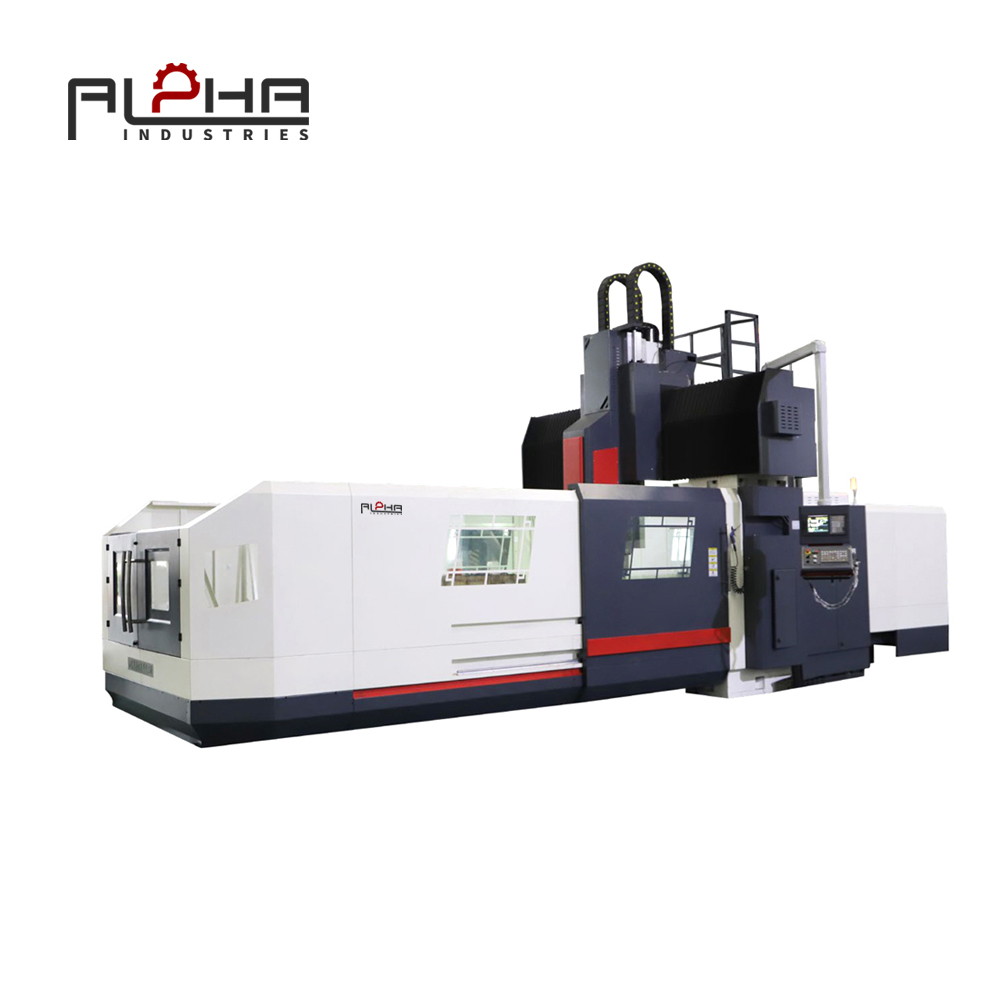
Understanding Gantry CNC Milling Machines
A gantry CNC milling machine features a bridge-style structure, where the spindle travels along a rigid gantry supported by columns on both sides of the machine bed.
This configuration is ideal for:
-
Large workpiece dimensions
-
Heavy component weights
-
High material removal rates
-
Long continuous machining cycles
Unlike conventional vertical machining centers, gantry mills are designed to minimize structural deformation over wide spans.
Structural Rigidity: The Foundation of Gantry Milling Accuracy
Why Rigidity Matters in Large CNC Milling
In gantry CNC milling, cutting forces are significantly higher due to:
-
Large cutter diameters
-
Deep cutting depths
-
Heavy workpiece mass
-
Extended machining time
Any structural flex will directly translate into:
-
Dimensional deviation
-
Surface waviness
-
Tool chatter
-
Inconsistent tolerances
Alpha gantry CNC milling machines are engineered to eliminate these issues at the structural level.
Heavy-Duty Gantry Frame Design
Alpha gantry milling machines utilize:
-
High-strength cast iron or welded steel gantry frames
-
Optimized crossbeam geometry
-
Finite element–optimized rib structures
This design ensures:
✔ Minimal deflection under load
✔ Uniform stress distribution
✔ Stable cutting behavior across the full travel range
The result is consistent dimensional accuracy, even when machining oversized components.
Dual-Column Support for Load Balance
Unlike single-column or cantilever designs, Alpha gantry CNC mills use dual-column support structures.
This provides:
-
Balanced load distribution
-
Reduced torsional deformation
-
Stable spindle alignment
Especially in wide-table machining, this structure maintains accuracy from edge to edge.
Thermal Stability: Accuracy Over Long Machining Cycles
The Hidden Threat of Thermal Deformation
In large CNC milling operations, heat buildup occurs due to:
-
Continuous spindle rotation
-
Long-axis travel
-
Extended cutting duration
Thermal expansion, if unmanaged, leads to micron-level dimensional drift, which accumulates over time.
Alpha’s Thermal Stability Engineering
Alpha gantry CNC milling machines are designed with:
-
Symmetrical machine structures
-
Optimized material selection
-
Heat-balanced axis layouts
This reduces thermal gradients and ensures:
✔ Stable geometry throughout long cycles
✔ Repeatable positioning accuracy
✔ Consistent surface quality
Thermal stability is especially critical in aerospace, mold, and heavy equipment machining.
High-Rigidity Crossbeam and Spindle Head System
The crossbeam and spindle head are key precision carriers in gantry CNC milling.
Alpha designs feature:
-
Reinforced crossbeam sections
-
High-load spindle head housings
-
Precision guideway alignment
This ensures the cutting tool maintains its programmed path even under aggressive milling conditions.
Guideway and Axis Stability for Large CNC Milling
Precision linear motion is essential for large-part machining.
Alpha gantry CNC mills employ:
-
Heavy-load linear guideways or hardened box ways
-
Precision-ground mounting surfaces
-
Rigid axis support over long travel distances
This prevents axis sag and ensures consistent tool positioning across the full working envelope.
Applications That Demand Gantry CNC Milling Rigidity
Industries that rely on gantry CNC milling include:
-
Aerospace structural components
-
Large mold and die manufacturing
-
Wind power equipment
-
Shipbuilding components
-
Heavy machinery frames
In these sectors, rigidity is not optional—it is mandatory.
Reduced Scrap and Higher Yield in Large-Part Production
Structural instability leads to:
-
Re-machining
-
Scrap parts
-
Missed delivery timelines
By prioritizing rigidity and thermal stability, Alpha gantry CNC milling machines help manufacturers achieve:
✔ Higher first-pass yield
✔ Lower rework rates
✔ Predictable machining outcomes
FAQ
What is a gantry CNC milling machine used for?
A gantry CNC milling machine is used to machine large, heavy, or long workpieces requiring high rigidity and precision.
Why is rigidity important in gantry milling?
Rigidity prevents structural deformation, ensuring dimensional accuracy and surface quality under heavy cutting loads.
How does a gantry mill differ from a vertical machining center?
Gantry mills offer a bridge-style structure with superior load capacity and stability for large-format machining.
Can gantry CNC mills maintain accuracy during long cycles?
Yes. With proper structural and thermal design, gantry CNC milling machines maintain accuracy throughout extended operations.
Why Choose Alpha Gantry CNC Milling Machines
Alpha focuses on engineering-driven gantry milling design, not generic machine assembly.
With Alpha gantry CNC milling machines, manufacturers gain:
-
Superior structural rigidity
-
Long-term thermal stability
-
Reliable large-part machining accuracy
-
Industrial-grade durability
Explore more machining solutions from Alpha:
👉 Gantry CNC Milling Machine Series
https://alpha-cnc.com/products/gantry-cnc-milling
👉 All Alpha Industrial CNC Machines
https://alpha-cnc.com/products